The Resistance Is Real (And It’s Not What You Think)
Let’s start with an honest moment.
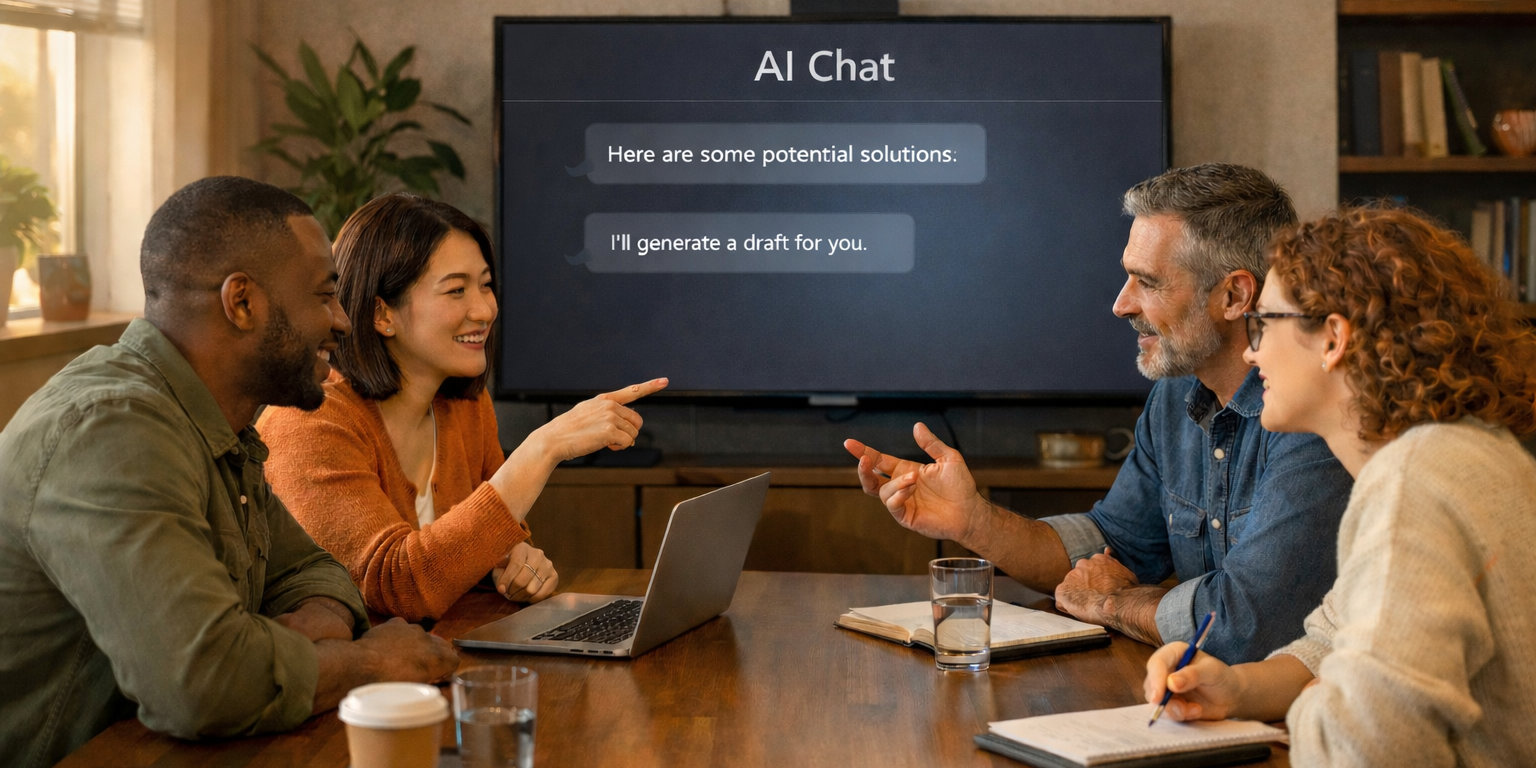
You’ve seen the potential. You’ve watched the demos, read the case studies, maybe even used AI tools yourself and felt that spark of this changes everything. So you brought it back to your team, ready to share the excitement — and you were met with crossed arms, polite nodding, or the kind of silence that says everything without saying a word.
It’s frustrating. You’re not trying to make anyone’s life harder. You’re trying to do the opposite. But somewhere between your vision and your team’s reality, something got lost in translation.
Here’s the first thing you need to understand: your employees’ resistance isn’t stubbornness. It’s fear. And fear, unlike stubbornness, can actually be worked with — if you know what’s driving it.
The Fear Beneath the Surface

When an employee pushes back on AI, what you’re usually seeing is the visible tip of something much deeper. On the surface, it might look like laziness, technophobia, or an unwillingness to adapt. But dig a little, and you’ll find something far more human underneath.
Fear of becoming obsolete. This one is loud, and it’s everywhere. According to a 2024 EY survey, 75% of employees worry AI could eliminate jobs — and 65% fear specifically for their own role. That’s not a fringe concern. That’s the majority of your workforce quietly wondering if they’re training their own replacement. And when 64% of managers report that their employees fear AI will make them less valuable at work, you start to realize this isn’t a perception problem you can simply talk your way around. It has to be addressed with intention.
Fear of losing their voice. This one is quieter, but often cuts even deeper — especially among your strongest performers. Writers, marketers, customer service leads, project managers — people who have spent years developing a craft and a working style that’s distinctly theirs. When you hand them an AI tool, what many of them hear is: “Your way of doing things isn’t good enough anymore.” The work they produce is tied to their professional identity. If a machine can do it, what does that say about them? This fear rarely shows up in a meeting. It shows up as avoidance.
Fear of being exposed. Not every employee is going to admit they don’t know how to use a new tool. In many workplace cultures, admitting confusion about technology feels like admitting weakness. So instead of asking for help, they quietly disengage. They’ll nod in the training session and then go right back to doing things the way they’ve always done them.
Fear of the unknown. And then there’s the catch-all: the general unease of watching the world shift beneath your feet. Your employees are consuming the same headlines you are — AI replacing call centers, AI writing code, AI doing in seconds what used to take hours. Even if they can’t articulate exactly what worries them, the ambient noise of disruption is enough to put people on the defensive.
What the Data Actually Shows
Here’s where it gets interesting — and where your job as a business owner becomes partly one of storytelling.
The fears your employees have are understandable. But many of them aren’t supported by the current evidence. The actual displacement numbers tell a very different story than the headlines suggest. MIT research estimates that AI is technically capable of handling work equivalent to about 11.7% of U.S. jobs — but that figure reflects technical capability, not real job cuts. In practice, roughly 119,900 AI-related roles were added in 2024, far outpacing confirmed AI-driven job losses. And when you zoom out to the global picture, automation and AI are projected to result in a net gain of approximately 78 million jobs worldwide by 2030.
The dominant trend isn’t elimination. It’s transformation.
But here’s the problem: your employees aren’t reading the economic research. They’re reading the headlines. And the headlines are terrifying.
The Generational Wrinkle
There’s one more layer worth understanding before you develop your approach, and that’s the generational divide running through most workplaces right now.
The gap is striking. Nearly 35% of Gen Z employees say they genuinely love AI tools at work — compared to just 13% of Baby Boomers who feel the same way. Younger workers aged 18 to 24 are actually 129% more likely than workers over 65 to fear AI will make their jobs obsolete — meaning the anxiety doesn’t just belong to older employees who are set in their ways. It cuts across age groups for very different reasons. Younger workers fear displacement early in their careers. Older workers fear being left behind by a learning curve they didn’t sign up for.
What this means practically is that there’s no single conversation to have, no one-size-fits-all rollout that speaks to everyone. Your 28-year-old graphic designer and your 54-year-old operations manager have different fears, different relationships with technology, and different definitions of what makes their work meaningful.
Reframing the Problem
So what do you do with all of this?
You stop treating resistance as a roadblock and start treating it as information.
Your employees aren’t anti-progress. They’re pro-security. They want to know their jobs are safe, that their contributions still matter, and that you’re not going to hand their livelihood over to a chatbot the moment it becomes financially convenient. Those are completely reasonable things to want — and the business owners who build genuinely AI-integrated teams are the ones who figure out how to honor those needs while still moving the company forward.
The resistance is real. But so is the path through it. And it doesn’t start with better software. It starts with a better conversation.
Why Mandating AI Backfires (And What Happens When You Do)
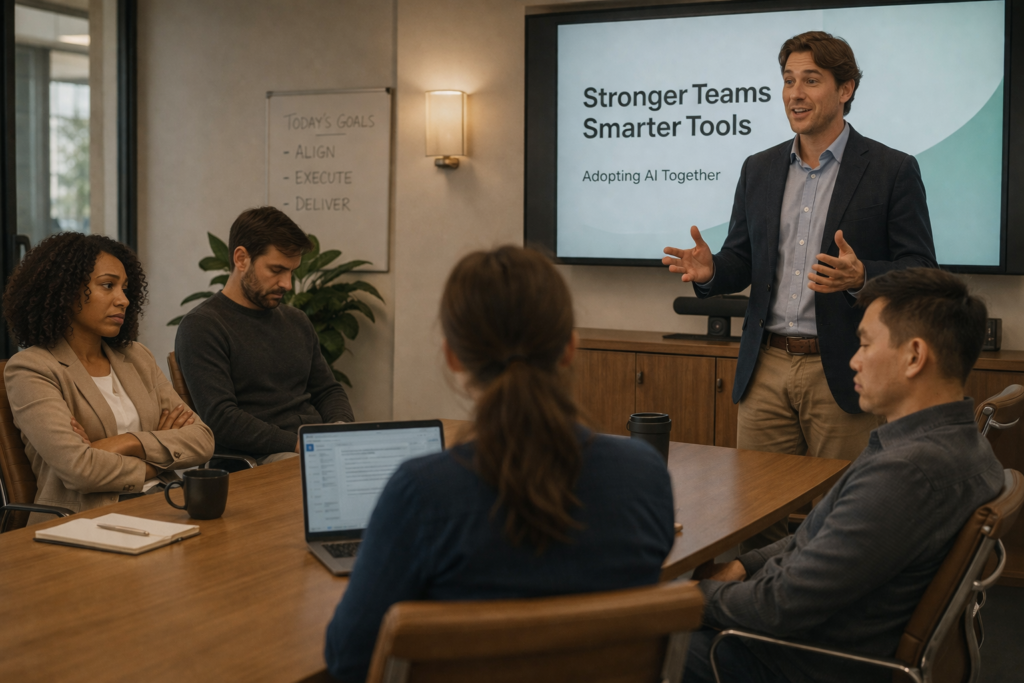
It’s a tempting move. You’ve invested in the tools, you’ve seen what they can do, and you’re running a business — not a debate club. So you make the call: AI is happening here, starting now, whether everyone’s on board or not.
It feels decisive. It feels like leadership.
It almost always makes things worse.
The instinct to mandate technology adoption is one of the most common mistakes business owners make — not because the goal is wrong, but because the method misreads how human beings actually change their behavior. And in the case of AI specifically, forcing the issue doesn’t just slow things down. It can quietly poison the well in ways that are hard to see and even harder to undo.
The Compliance Trap
Here’s what top-down AI mandates actually produce: compliance theater.
Your employees will use the tool. They’ll check the box. They’ll show up to the training, generate the output, and submit it — all while doing the bare minimum to satisfy the requirement and mentally checking out of the process entirely. On paper, you have an AI-integrated team. In reality, you have a team that has learned to perform AI adoption without actually doing it.
This matters because the value of AI in your business doesn’t come from surface-level usage. It comes from employees who are genuinely experimenting with it, learning its edges, figuring out where it helps and where it doesn’t, and building it into the way they actually work. That kind of integration cannot be mandated. It has to be grown.
The research backs this up clearly. Studies show that 70–80% of AI projects fail to deliver their expected benefits — and the culprit usually isn’t the technology. It’s the people side of the equation. Up to 70% of change initiatives, including AI adoption, collapse due to employee pushback or inadequate management support. The technology worked fine. The adoption strategy didn’t.
What You’re Actually Risking
Beyond the productivity shortfall, forced adoption carries some quieter costs that business owners often don’t see coming until the damage is done.
You lose trust. When employees feel like a decision has been made for them rather than with them, they read it as a signal about how you see them. Not as skilled professionals whose judgment matters, but as positions to be optimized. That’s a hard feeling to shake — and it doesn’t stay contained to the AI conversation. It bleeds into overall morale, communication, and the kind of discretionary effort that separates a good team from a great one.
You create resentment toward the tool itself. This is subtle but powerful. When something is forced on you, you become primed to notice every time it fails. Every awkward AI output, every clunky workflow, every moment where the tool gets it wrong becomes confirmation of what the employee already believed: this was a bad idea. You’ve essentially handed your most skeptical employees a magnifying glass and pointed it at every flaw. Good luck recovering from that.
You signal that efficiency beats people. Even if that’s not your intention, mandatory AI rollouts — especially when they’re rushed and under-explained — send a message. When 64% of managers already report that their employees fear AI will make them less valuable, the last thing you want to do is confirm that fear through your actions. A top-down mandate, delivered without context or conversation, does exactly that.
You risk losing your best people. The employees who care most about the quality of their work are often the most resistant to AI tools — because they have the highest standards for what good output looks like. Push too hard, too fast, and you may not lose them immediately. But you’ll see it in subtle ways: decreased initiative, less creative risk-taking, the slow withdrawal of the energy that made them valuable in the first place. In a worst case scenario, they leave. And they don’t always tell you why.
The Middle Manager Problem
There’s another wrinkle here that business owners in small-to-mid-sized companies often overlook: the role of middle management in killing AI adoption before it ever reaches the front lines.
Even if you’re genuinely committed to a people-first rollout, your message gets filtered through every layer of your organization. And only 34% of managers report feeling equipped to support AI adoption in their teams. That means two-thirds of the people responsible for translating your vision into daily practice don’t actually know how to do it — and rather than admit that, many of them simply become passive obstacles. They don’t actively resist. They just don’t champion. And in the absence of active encouragement, most employees will default to the path of least resistance: doing what they’ve always done.
Gallup’s research makes this point sharply. Managers who actively encourage AI use don’t just improve adoption rates — they help their teams find the applications that actually fit real workflows and solve real problems. The inverse is also true. Managers who are disengaged from the process, whether because they’re skeptical themselves or simply undertrained, are among the most reliable predictors of failed rollouts.
The Difference Between Compliance and Buy-In
This is the distinction that everything else hinges on.
Compliance is an employee using an AI tool because they have to. Buy-in is an employee using it because they want to — because they’ve seen it make their work better, faster, or more interesting, and now they’d miss it if it were gone.
Those two states produce completely different outcomes for your business. A compliant team meets the minimum. A bought-in team innovates. A compliant team will stop using the tool the moment supervision relaxes. A bought-in team will find new applications you never thought of and teach each other without being asked. The research even suggests that some of the most valuable AI use cases in an organization don’t come from leadership at all — they come from employees on the ground who have been given the freedom and safety to experiment. The best ideas, it turns out, often come from the edge, not the center.
You cannot mandate your way to buy-in. But you can create the conditions for it.
So What Does Work?
The short answer: meeting people where they are.
Not where you wish they were. Not where they’d be if they just read the same articles you’ve been reading. Where they actually are — which is somewhere between skeptical and scared, trying to do good work, and quietly wondering whether you’re about to make their job harder or eliminate it entirely.
The business owners who successfully integrate AI into their teams are not the ones who issued the strongest mandates. They’re the ones who had the patience to build trust first — who treated adoption as a culture shift rather than a software rollout, and who understood that the fastest path to genuine AI integration is, counterintuitively, a slower, more human one.
What that path looks like in practice is exactly what we’ll cover next.
The Identity Reframe — Helping Employees See AI as a Tool, Not a Threat
Before you can change how your employees use AI, you have to change how they think about it.
This is the step most business owners skip. They go straight to the tools — the demos, the subscriptions, the training sessions — without ever addressing the story their employees are telling themselves about what AI means for them personally. And as long as that story stays unchallenged, no amount of onboarding will stick.
The story most resistant employees are telling themselves sounds something like this: “If AI can do what I do, then what I do doesn’t matter. And if what I do doesn’t matter, then neither do I.”
That’s not a technology problem. That’s an identity problem. And it requires a fundamentally different kind of conversation.
We Have Been Here Before
Let’s start with some perspective — because history has a way of making the present feel a lot less terrifying.
Think back to when spell-check became standard. There were writers and editors who genuinely worried that automated spell-checking would erode the craft of writing, that it would make people lazy, that it would devalue the skill of knowing how to construct a sentence correctly. Did it replace writers? No. Did it make them less skilled? No. What it did was eliminate the tedium of hunting for typos so that writers could spend more of their energy on the thing that actually mattered — the thinking, the voice, the ideas.
The same argument played out with calculators replacing mathematicians, GPS replacing navigators, search engines replacing encyclopedias, and spreadsheets replacing accountants who did their work by hand. In every single case, the technology didn’t eliminate the human — it eliminated the most tedious parts of the human’s job and freed them to operate at a higher level.
Here’s what that history tells us: the early adoption patterns of AI for work are broadly similar to the adoption of personal computers in the early 1980s. We have navigated this kind of shift before. We adapted. We got better at our work, not worse. And the professionals who learned to use the new tools didn’t become less valuable — they became more valuable, because they could now do things that their non-adopting peers couldn’t.
The parallel isn’t perfect. AI is more capable, more versatile, and moving faster than any previous technology shift. But the fundamental dynamic — humans adapting to powerful tools and emerging more capable on the other side — is not new. Reminding your employees of that isn’t spin. It’s accurate.
The Amplifier Reframe
Here is the single most important conceptual shift you can help your employees make: AI is not a replacement for what they bring to the table. It is an amplifier of it.
A replacement takes something away. An amplifier makes it bigger.
Your customer service lead who has spent a decade learning how to de-escalate difficult clients, reading tone, choosing the right words under pressure — AI cannot replicate that. What AI can do is handle the routine inquiries that eat up four hours of her day so she can spend more time doing the high-stakes, high-empathy work that only she knows how to do.
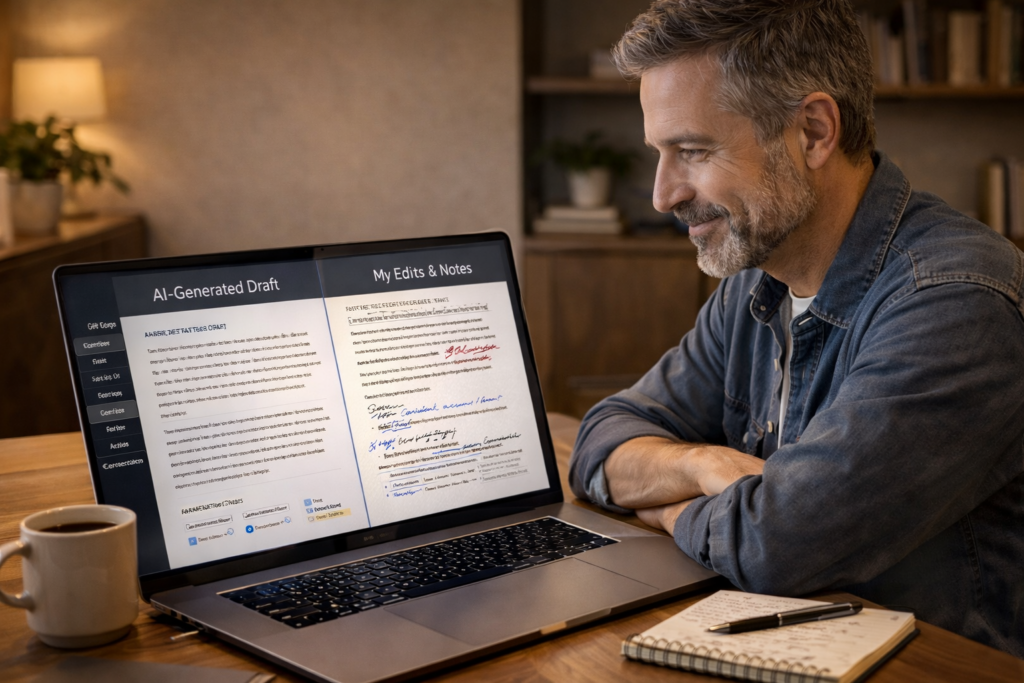
Your content writer who has spent years developing a brand voice that resonates with your audience — AI cannot replicate that either. What it can do is produce a first draft that he shapes, refines, and elevates with the judgment and instinct that only comes from his experience. The voice in the final product is still his. The craft is still his. He just got a capable assistant that handles the blank-page problem so he can focus on the craft itself.
This reframe isn’t just motivational language. The data supports it. Studies across writing, customer support, software development, accounting, and legal work consistently show task-completion time reductions of 15% to more than 50% — with the largest benefits going to less experienced workers. AI doesn’t flatten expertise. It compresses the gap between novice and expert, which means your most experienced employees retain their edge while your newer ones get up to speed faster. Everybody wins.
And the labor market is already reflecting this. AI-skilled workers are now commanding an average wage premium of 56% compared to their peers without AI skills — double the premium from just the year before. The market isn’t paying more for people who’ve been replaced by AI. It’s paying more for people who’ve learned to work alongside it. That’s a powerful data point to put in front of a skeptical employee.
Addressing the “Is It Still My Work?” Question
This one deserves its own honest conversation, because it’s the question a lot of employees are thinking but rarely say out loud.
When a writer uses AI to help draft a proposal, is it still their work? When a designer uses AI to generate a starting concept they then refine, does that design still represent their talent? These aren’t abstract philosophical questions — they go right to the heart of how your employees derive meaning and satisfaction from what they do.
Here’s a useful way to think about it, and to talk about it with your team.
An architect who uses CAD software to produce a building design didn’t have a computer build the building. The creative decisions, the spatial judgment, the understanding of what the client needs and how to translate that into a structure — all of that is still the architect. The software is a production tool. The architecture is still entirely theirs.
The same logic applies to AI. When an employee uses AI as part of their process, the direction is still theirs. The judgment is still theirs. The understanding of the audience, the client, the problem — all still theirs. AI doesn’t know your business. It doesn’t know your customer. It doesn’t know the context behind why this particular email needs to land a certain way or why this particular project has to be approached carefully. Your employee does. That knowledge is irreplaceable — and it’s precisely what makes the AI output useful rather than generic.
The work is still theirs. The AI just helped carry some of the weight.
The Language That Actually Works
Knowing what to say is one thing. Knowing how to say it in a way that lands is another. Here are some practical approaches that tend to open people up rather than shut them down.
Replace “AI will make your job easier” with “I want to hear what parts of your job you find most draining.” The first statement is about the technology. The second is about the person. Starting from their experience — their actual daily frustrations — signals that you’re not trying to overhaul their identity. You’re trying to remove the things that get in the way of their best work.
Replace “everyone needs to be using this” with “let’s find one thing this might help you with.” Scope matters enormously. A sweeping mandate feels like a takeover. A single, specific experiment feels manageable — even interesting. One task, one week. If it helps, great. If it doesn’t, you move on. That’s a conversation most people can say yes to.
Replace “AI is the future” with “tools have always changed — your judgment hasn’t.” This acknowledges the shift without dismissing their concern, and it grounds the conversation in a truth they already know: that they’ve adapted to new tools before, and their core value has always been what they know, not the instrument they used to apply it.
Don’t oversell it. Your employees can tell when they’re being managed. If you walk in talking about AI like it’s going to solve everything, you’ll lose them before you start. Acknowledge that it’s not perfect. Acknowledge that there’s a learning curve. Acknowledge that some of what’s out there right now isn’t great, and that part of the process is figuring out where it helps and where it doesn’t. That honesty builds more trust than a polished pitch ever will.
Confidence Is the Real Barrier
Here’s a finding that gets to the heart of all of this: 75% of employees lack confidence in using AI, and 40% struggle to understand how it fits into their specific role. The resistance your employees are showing you is, in many cases, not really about AI at all. It’s about not wanting to look incompetent in front of their colleagues and their boss.
Fear shrinks when people feel capable. The employees who move from skeptic to advocate are almost never the ones who were suddenly convinced by an argument. They’re the ones who sat down with the tool, figured out something that actually worked, and felt that quiet shift in confidence that comes from realizing: I can do this. And it actually helps.
Your job isn’t to convince your employees that AI is great. Your job is to create the conditions where they can discover that for themselves — safely, without pressure, and with enough support that the learning curve doesn’t feel like a cliff.
That’s where the real work of adoption begins. And it’s exactly where we’re headed next.
The Playbook — A Practical, People-First Approach to AI Adoption

Everything up to this point has been about understanding the problem. Now let’s talk about solving it.
The good news is that getting a resistant team to genuinely embrace AI doesn’t require a massive budget, a consultant, or a company-wide initiative. It requires a smarter approach — one that puts people before process and proves value before demanding commitment. Here’s what that looks like in practice.
Start With Pain Points, Not Products
Before you introduce a single tool, ask your employees a simple question: What part of your day do you wish you could get back?
This does two things. First, it signals that this is about making their work better, not monitoring or replacing them. Second, it gives you a map. When you know what’s actually draining your team — the repetitive reporting, the email back-and-forth, the first-draft paralysis — you can introduce AI as a direct answer to a problem they already feel. That’s a fundamentally different conversation than “here’s a tool leadership wants us to use.”
The data reinforces this approach. Gallup found that the number one barrier to AI adoption is an unclear use case — 44% of non-users say the main reason they don’t use AI is simply that they don’t see how it applies to their work. Show them how it applies to their specific frustrations, and that barrier disappears.
Small Wins Over Big Rollouts
Resist the urge to overhaul everything at once. A sweeping, company-wide AI rollout is the fastest way to overwhelm people who are already skeptical. Instead, pilot with one task, one person or team, over a defined window of time — two weeks is often enough to see meaningful results.
The goal of this phase isn’t transformation. It’s a single moment where an employee thinks that actually saved me time. Workers using AI regularly report saving an average of 5.4% of their work hours per week — and among daily users, a third report saving four or more hours weekly. That’s not an abstract statistic once someone experiences it personally. It’s a convert.
Small wins compound. One person’s genuine enthusiasm is worth more than ten mandates.
Let the Skeptics Lead
This is the move most business owners don’t see coming, and it’s one of the most effective in the playbook.
Instead of piloting AI with your most enthusiastic employees, bring your most vocal skeptics into the process early — and give them actual ownership over it. Ask them to evaluate the tool. Ask for their honest feedback. Put them in the position of expert, not subject.
This works for a simple reason: resistance is often just unspent energy looking for direction. When a skeptic becomes the person responsible for figuring out whether something works, their entire relationship with it changes. They’re no longer being sold to — they’re the one doing the evaluating. And when they find something that genuinely helps, they become your most credible internal advocates. Their buy-in carries weight precisely because everyone knows they weren’t easy to convince.
Celebrate the Human Output, Not the AI
This one is small but matters more than you’d think. When an employee uses AI to produce something great, make sure the credit lands on them — not the tool.
“Sarah put together an incredible client proposal this week” lands very differently than “Sarah used AI to put together a proposal this week.” The first celebrates a person. The second, however unintentionally, plants a question about how much of it was really hers.
Your employees are watching how you talk about AI-assisted work. If they sense that using AI will diminish how their contributions are perceived, they’ll quietly avoid it. Reinforce consistently that the judgment, the direction, and the final product belong to them. The tool is a means. The outcome is theirs.
Train for Confidence, Not Just Competency
Most AI training focuses on the how — here’s the interface, here’s how to write a prompt, here’s where to click. That’s necessary, but it’s not sufficient. What moves the needle on actual adoption is training that builds confidence — the feeling that someone knows enough to experiment without fear of looking foolish.
Keep early training sessions small, informal, and low-stakes. Pair people up so no one is learning alone. Create a channel — a Slack thread, a standing meeting, a shared document — where employees can share what’s working without judgment. Normalize the learning curve openly, from the top down. When leadership admits they’re still figuring it out too, it gives everyone else permission to do the same.
The research is clear on this: 48% of employees say better training would significantly improve their adoption rates. But “better” doesn’t mean longer or more technical. It means more human, more contextual, and more connected to the actual work they’re doing every day.
The Long Game — Building a Culture Where AI Makes Your People Better

Here’s what nobody tells you about AI adoption done right: six months from now, the conversation in your business won’t be about AI at all.
It’ll be about the client you landed because your team turned around a proposal faster than any competitor could. The product improvement that came from an employee who finally had time to think strategically instead of drowning in administrative work. The team member who used to dread Monday mornings and now comes in with ideas. The version of your business that moves faster, thinks bigger, and still feels unmistakably human.
That’s the destination. And the path there runs directly through your people.
What the Other Side Looks Like
When AI adoption happens the right way — gradually, honestly, with genuine respect for the people doing the work — the results compound in ways that go far beyond productivity metrics.
The numbers are already telling that story. Employees using AI report an average productivity boost of 40%. Industries most exposed to AI are seeing revenue per employee grow at three times the rate of industries that haven’t engaged with it — 27% compared to just 9%. And critically, among organizations that are investing in AI and seeing real productivity gains, only 17% used those gains to reduce headcount. The vast majority reinvested them — into new capabilities, into R&D, into developing their people.
The fear that AI adoption leads inevitably to a smaller, cheaper workforce isn’t just overstated. For most businesses that approach it thoughtfully, it’s simply wrong.
The Culture Shift That Makes It Stick
The businesses that sustain AI adoption long-term aren’t the ones with the best tools. They’re the ones that built a culture of psychological safety around trying new things — where an employee can experiment with AI on a project, have it not work perfectly, and feel comfortable saying so without consequence.
That culture doesn’t happen by accident. It’s built conversation by conversation, decision by decision, by leaders who consistently demonstrate that the point of AI isn’t to squeeze more output from fewer people — it’s to make good people capable of doing things they couldn’t do before.
When employees feel that, everything changes. They stop waiting to be told how to use AI and start figuring it out on their own. They share what they discover. They teach each other. The adoption that you were once trying to mandate starts happening organically, driven by the team itself — because they’ve experienced firsthand what it feels like to do their best work with better support behind them.
Your Competitive Window Is Open — But Not Forever
There’s a timing element here that business owners can’t afford to ignore.
Right now, you have a genuine window to build a team that is ahead of this curve — not so far behind that catching up is painful, and not so pressured that you have to force it. The companies that will look back on this era as a turning point are the ones that treated AI adoption as a leadership challenge first and a technology challenge second.
That means your job isn’t to become an AI expert. It’s to become the kind of leader your team trusts enough to follow into unfamiliar territory. To be honest about what you don’t know. To create space for people to learn without fear. To make it clear, through your actions and not just your words, that no one is being left behind.
The Bottom Line
Your most skeptical employee isn’t your obstacle. They might just be your greatest untapped opportunity.
The moment they move from resistance to genuine engagement — the moment they feel the shift from this is being done to me to this is actually helping me — is the moment your AI adoption stops being a project and starts being a culture. And cultures, unlike software rollouts, don’t stall out. They grow.
The businesses that figure out the people side of AI won’t just be more productive. They’ll be better places to work. They’ll attract better talent, retain the people they already have, and build something that no competitor can simply purchase a subscription to replicate.
The tools are available to everyone. What isn’t available to everyone is a team that genuinely knows how to use them — and a leader who knew how to bring them along.
That’s the real competitive advantage. And it starts with the next conversation you have with your team.
Ready to See What This Looks Like for Your Business?
You’ve just spent time thinking differently about AI — not as a cost-cutting mandate, but as a genuine opportunity to make your people better at what they do. That shift in thinking is the hardest part. The next step is a lot more straightforward.
At Intellic Labs, we don’t believe in generic demos or one-size-fits-all AI solutions. The same way this article asked you to meet your employees where they are, we meet your business where it is — inside your actual workflows, your real tools, and the specific friction points that are costing you time and revenue right now.
That’s why we created something a little different.
We’ll build you a free, custom AI walkthrough video — made specifically for your business.
Not a slide deck. Not a product overview. A short video built around your systems, your team, and your goals — so you can see exactly where AI can reduce friction, drive revenue, and create a better experience for both your customers and your people.
In your custom video, you’ll see:
✅ Where AI plugs into your existing stack — CRM, support, email, docs, and operations tools
✅ Which workflows can be fully automated end-to-end, not just “assisted”
✅ How we measure real ROI — cycle time, cost-to-serve, conversion, and resolution speed
✅ How we avoid the vendor lock-in and static platforms that leave most businesses stuck
No sales pressure. No buzzwords. No generic AI overview that could apply to any company on the planet. Just an honest look at what’s actually possible inside your operation — before you spend a dollar or a month in pilot purgatory.
We produce seven of these each week. Spots move quickly.
👉 Claim your free custom AI walkthrough video
Your team has more potential than any tool can unlock on its own. Let Intellic Labs help you show them what’s possible.