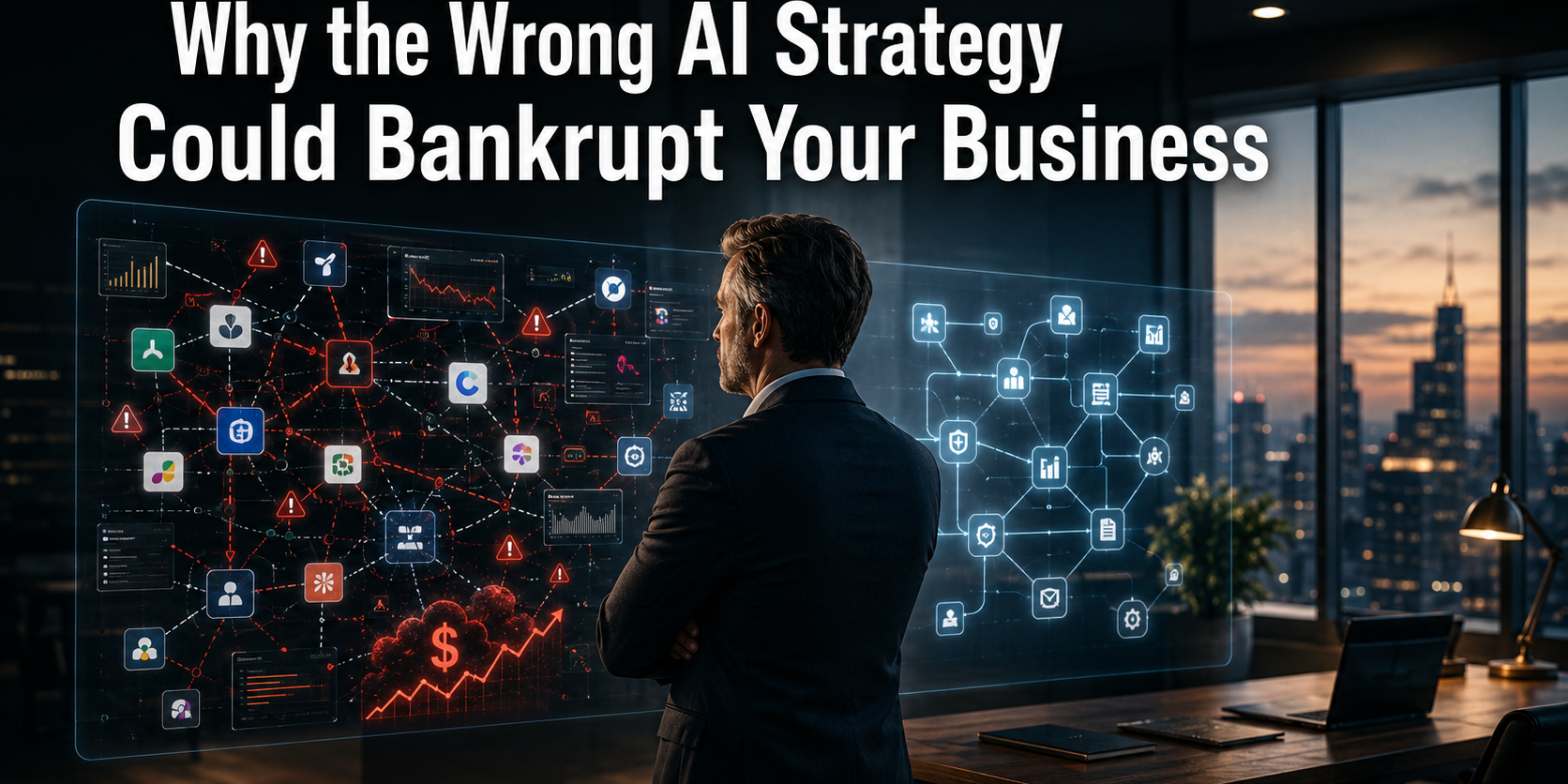
Your AI Strategy May Be Your Doom
Your AI strategy may not save your business.
It may bankrupt it.
Not because AI is useless. Not because ChatGPT is bad. Not because every new AI tool is a scam.
The real danger is more subtle than that.
AI works.
And because it works, businesses are rushing into it faster than they can think. They are buying tools, testing agents, subscribing to platforms, giving employees ChatGPT, plugging in writing apps, trying coding assistants, experimenting with customer service bots, and calling all of it an “AI strategy.”
But scattered adoption is not strategy.
It is spending.
And spending can get out of control very quickly when nobody knows what the final system is supposed to become.
Look at Uber.
This is not a small company stumbling into AI with no technical talent. This is Uber, one of the most sophisticated technology companies in the world. Yet even Uber misjudged how quickly AI costs could scale. According to Business Insider, Uber’s CFO said the company had underestimated the impact AI tools would have when it set its 2026 budget. Its CTO also said Uber had already spent its entire 2026 budget for Claude by April — roughly four months into the year.

That is the part business owners need to understand.
Uber did not run into this problem because AI failed.
It ran into this problem because AI was useful enough to spread faster than expected, and because AI is expensive.
It can be very expensive.
That is a very different warning.
When AI works, people use it more. When they use it more, costs rise. When costs rise without a plan, finance gets surprised. Then leadership has to decide whether to cut elsewhere, renegotiate, rebuild, restrict usage, or keep pouring money into a system that may already be changing how the company operates.
Now imagine that same problem inside a smaller business.
No AI governance.
No integration plan.
No cost controls.
No clear owner.
No data strategy.
No long-term architecture.
Just a pile of subscriptions and a vague belief that “we need to use AI.”
That is where companies get into trouble.
At first, the damage does not look dramatic. It looks like progress. The team is excited. The tools are impressive. The demos look amazing. Everyone feels faster.
Then the hidden costs start showing up.
One tool does not talk to another. Business and customer data get copied between tools. Employees need training on five different systems. Managers do not know which output to trust. Customers receive inconsistent answers. A vendor changes pricing. Another tool falls behind. Another gets acquired. Another cannot scale. Suddenly, the company is not building an AI-powered business.
It is managing AI chaos.
And chaos is expensive.
The lesson is not that businesses should avoid AI. That would be even worse.
The lesson is that AI is moving too fast to wing it.
You do not need a massive budget on day one. You do not need a hundred-page transformation plan. You do not need to rebuild your whole company overnight.
But you do need the bones of a real strategy.
You need to know where AI belongs in your business. You need to know what systems it should connect to. You need to know what data it can use. You need to know who controls it, how it scales, how costs are managed, and what happens if one of your vendors disappears, falls behind, raises prices, or traps you inside their platform.
Because the wrong AI strategy does not usually kill a business in one obvious moment.
It bleeds it.
A little more cost here.
Another tool.
Another login.
Another training session.
Another migration.
Another restart.
Another vendor you cannot leave.
And while you are trying to keep all of that stitched together, your competitor may be building something cleaner, faster, and far more durable.
That is the real danger.
Not AI.
AI without a strategy.
And let’s face it, just like with the early internet, many of the AI companies that exist today will not be around in the next few years. Some will be acquired. Some will pivot. Some will run out of money. Some will fall behind. Some will shut down the very products their customers built workflows around.
Even OpenAI, the 800-pound gorilla in this market, recently discontinued Sora’s web and app product with only about a month’s notice, while giving developers roughly six months before the API is discontinued. If a company had built client services, internal workflows, or marketing operations around that tool, the cost would not just be inconvenience. It would mean finding an alternative, retraining employees, rebuilding processes, explaining delays to clients, and absorbing the damage.
Catch-up instead of progress.
In an age where businesses need to move faster than ever before.
That is why AI strategy matters. You should absolutely use AI tools, but you should not bet your business on guessing which vendors, products, or platforms will survive. Build with flexibility. Keep an exit path. Make sure one company’s sudden decision does not force your company to start over.
The ChatGPT Trap
The easiest mistake a business can make with AI is believing that access equals strategy. A company signs up for ChatGPT, gives employees permission to use it, maybe adds an off-the-shelf AI chatbot to the website, and suddenly leadership feels like the business has entered the AI age.
At first, it looks like progress. Employees write emails faster. Marketing creates content faster. Support drafts better replies. Sales gets help with follow-up messages. The website chatbot answers a few basic questions without bothering the team.
That is useful.
But it is not transformation.
In many companies, this kind of AI use creates only a small edge because most of the old work is still there. Employees are still copying information from one system, pasting it into another, checking the AI output, rewriting pieces, moving data manually, and fixing mistakes. The AI may save time in one part of the process, but much of that gain is eaten up by the fact that the business itself has not changed.

The same problem shows up with many off-the-shelf AI support or sales bots. They may answer basic questions. They may collect leads. They may summarize a conversation. But if they are not connected to live backend systems, customer history, order records, billing information, inventory, scheduling, internal policies, or support workflows, they can only go so far.
They become a smarter FAQ.
And a smarter FAQ is not going to save your business from a competitor that is redesigning the entire machine.
That is the real danger.
Company A gives employees ChatGPT and adds a basic AI chatbot. The staff becomes a little more productive. Customers get answers to simple questions. Maybe the company saves some time. Maybe it looks more modern. Maybe the owner feels like they are keeping up.
Company B does something very different.
Company B uses AI to offload a major share of sales qualification, customer follow-up, customer service, appointment scheduling, internal reporting, lead nurturing, onboarding, and routine operational work. Its AI is not sitting off to the side like a toy. It is connected to the systems that run the business. It can see the customer record. It can update the CRM. It can trigger follow-ups. It can route exceptions to humans. It can answer based on current data. It can support the team across phone, SMS, email, web chat, and internal workflows.
Now Company B is not just saving a few minutes here and there.
It is changing its cost structure.
If AI can handle large portions of sales follow-up, customer service, and routine administrative work, the company may save hundreds of thousands of dollars a month. They can then redirect dozens of employees to growth opportunities, or even reduce staff by 30%. It can reinvest that money into better marketing, better people, better products, better customer experiences, and faster growth.
That is the part many business owners are missing.
Company A gets a small productivity boost.
Company B reinvents how the business operates.
That is not a fair fight.
It is not two companies holding similar weapons. Company A has a pistol. Company B is flying an Apache helicopter. And Company A is still congratulating itself because the pistol has a laser sight.
This is what you are up against.
The point is not that every business needs to automate 80% of sales, 90% of follow-up, and 80% of support on day one. That would be unrealistic for most companies. The point is that your AI strategy needs to be pointed in that direction. It needs to have room to grow from simple use cases into deeper business integration.
Because if your entire AI strategy is built around a generic chatbot or a narrow off-the-shelf tool, what happens when you are ready for more?
What happens when you need that chatbot to connect to your CRM, billing system, scheduling platform, customer database, internal documents, service records, inventory, email, SMS, or phone system? What happens when you need custom workflows? What happens when you need it to make decisions based on live business data instead of stale training material or a few uploaded documents?
Do you hope the vendor adds those features?
Do you wait?
Do you pay more?
Do you rebuild everything?
Do you start over with another tool?
That is where the ChatGPT-only trap becomes expensive. The danger is not that ChatGPT is useless. It is that it can make your company feel like it is adopting AI while a competitor is using AI to remove entire layers of cost and friction from the business.
One strategy makes people a little faster.
The other makes the company fundamentally harder to compete with.
That is why access to AI is not enough. A serious business needs to think beyond prompts, chat windows, and basic bots. It needs to ask where AI can actually change the economics of the company.
Because in the AI era, the winner may not be the company that uses the most tools.
It may be the company that needs the fewest people, moves the fastest, serves customers the best, and reinvests the savings before everyone else understands what happened.
The Patchwork AI Trap
Some companies will avoid the ChatGPT-only mistake and walk straight into another one.
They will buy a different AI tool for everything.
One for writing. One for meetings. One for sales. One for customer service. One for social media. One for analytics. One for project management. One for phone calls. One for email.
At first, that looks like a strategy.
It is not.
It is AI sprawl.
Each tool may be useful by itself. But if those tools do not talk to each other, they create a new kind of mess. Sales has one version of the customer. Support has another. Marketing is using different language. Operations is working from different data. Leadership is trying to figure out which system is telling the truth.

That is not an AI-powered business.
That is a business with a dozen disconnected assistants.
And every one of them has to be paid for, managed, learned, updated, secured, checked, and eventually replaced when it falls behind.
This is where AI gets expensive.
The real cost is not just the subscription fee. It is the training. The confusion. The integrations. The data cleanup. The duplicated work. The customer frustration. The downtime. The migration when one tool stops working for your needs.
Worse, this kind of setup makes the business slower at the exact moment AI is supposed to make it faster. Every change becomes harder because every tool is another dependency. Every improvement has to fight through another vendor, another interface, another workflow, another limitation.
A dozen AI tools may look impressive on a spreadsheet.
But if they are not part of one clear system, they are just a dozen new places for your business to break.
Many AI Companies Will Disappear
Let’s be honest. Just like the early internet, many of the AI companies that exist today will not be around in the next few years.
Some will be acquired. Some will pivot. Some will run out of money. Some will fall behind. Some will get crushed by larger companies. Some will shut down the product you built your process around.
This is not theory.
Builder.ai was once a high-profile AI startup backed by Microsoft and Qatar’s sovereign wealth fund. It promised to make app and website development easier through AI. Then it collapsed into insolvency after financial problems, debt defaults, and major questions about its business. Financial Times reported that the company had debts including $85 million owed to Amazon and $30 million owed to Microsoft.

Now imagine your business had bet a major workflow on that company.
Maybe you used it to build client apps. Maybe your sales team promised faster delivery because of it. Maybe your customers expected work to move through that platform. Maybe your staff had been trained around its process. Then the company collapses, and suddenly your “AI strategy” becomes a scramble.
You have to find a replacement. Move data. Rebuild processes. Retrain employees. Explain delays to clients. Absorb mistakes. Eat costs. Lose momentum.
And Builder.ai is not the only warning sign. As we already discussed, even OpenAI discontinued Sora’s web and app experiences on April 26, 2026, with the API scheduled to end on September 24, 2026. That is OpenAI, the 800-pound gorilla of the AI market.
So yes, use AI tools.
But do not bet your business on guessing which companies, products, or platforms will survive. Your strategy needs flexibility. It needs an exit path. It needs a way to replace tools, switch providers, and keep moving without starting over every time the market changes.
Vendor Lock-In Is More Dangerous in the AI Era
Vendor lock-in has always been a problem.
In the AI era, it can become a business killer.
Why? Because AI is moving too fast. The best tool today may be average six months from now.
That creates a serious problem if your business is trapped inside that tool.
If all your customer conversations, sales workflows, support processes, documents, automations, and internal knowledge are tied to one vendor, you do not really control your AI strategy. The vendor does. Their roadmap becomes your roadmap. Their limits become your limits. Their pricing becomes your problem.

And when you finally need something more advanced, you may discover the trap.
You need custom workflows, but they do not offer them. You need to connect to your back office systems, but the integrations are shallow. You need live customer data, but the tool only works from uploaded files. You need voice, SMS, email, web chat, and CRM updates working together, but the platform was never built for that.
So now what?
You wait and hope they build it. You pay more. You patch together another tool. Or you start over.
None of those are good options.
This is why businesses need to think about the exit before they commit. Can you export your data? Can you switch AI providers? Can you keep your workflows? Can the system grow with you? Can it be customized? Can you license it, self-host it, or buy the source if the need becomes serious enough?
If the answer is no, be careful.
You may not be buying an AI system.
You may be renting a cage.
You Do Not Need a Giant Budget
The answer is not to panic and spend a fortune overnight.
That is another mistake.
Some business owners hear warnings like this and assume they need to launch a massive AI transformation project, hire a full AI department, rebuild every workflow, and throw money at every new tool before their competitors do. That is not strategy either. That is fear with a budget.
You do not need to start huge.
But you do need to start with the right foundation.

A serious AI strategy can begin with one important workflow. Maybe customer follow-up is the biggest leak in the business. Maybe support is eating too much time. Maybe sales qualification is inconsistent. Maybe internal knowledge is scattered across documents, emails, and people’s heads. Maybe your team spends hours every week doing repetitive work that AI could help handle.
Start there.
Pick a problem that matters. Build around it carefully. Make sure the system can connect to the data it needs. Make sure it can grow into other parts of the business later. Make sure you are not choosing a dead-end tool that solves one narrow problem today and becomes a wall tomorrow.
That is the key difference.
A bad AI strategy chases tools.
A good AI strategy builds capacity.
You may begin with something simple, like an AI assistant that helps with customer questions. But if you choose correctly, that assistant can later connect to your CRM, support tickets, scheduling system, billing data, email, SMS, phone calls, internal documents, and reporting. It can start as one useful tool and grow into part of the operating system of the business.
That is how you avoid the restart penalty.
You do not have to build the whole thing at once. But you should know what the next steps could look like. You should know whether the system can expand, integrate, customize, and adapt as your needs change. You should know whether you can replace pieces without throwing the whole thing away.
This is where many businesses will go wrong. They will choose the cheapest or flashiest tool that solves today’s problem, without asking whether it can support tomorrow’s business. Then, six months later, they will need more. More integrations. More customization.
And the tool will not be able to do it.
So they start over.
That is the expensive part.
The goal is not to spend the most money. The goal is to spend in a way that compounds. Every AI step should make the next step easier, not harder. Every workflow should create a stronger foundation, not another disconnected island. Every tool should either fit into the larger strategy or be temporary by design.
You do not need a giant AI budget.
You need the bones of a system that can grow.
Ready to See What AI Looks Like for Your Business?
At Intellic Labs, we don’t believe in generic demos or one-size-fits-all AI solutions. The same way this article asked you to meet your employees where they are, we meet your business where it is — inside your actual workflows, your real tools, and the specific friction points that are costing you time and revenue right now.

That’s why we created something a little different.
We’ll build you a free, custom AI walkthrough video — made specifically for your business.
Not a slide deck. Not a product overview. A short video built around your systems, your team, and your goals — so you can see exactly where AI can reduce friction, drive revenue, and create a better experience for both your customers and your people.
In your custom video, you’ll see:
✅ Where AI plugs into your existing stack — CRM, support, email, docs, and operations tools
✅ Which workflows can be fully automated end-to-end, not just “assisted”
✅ How we measure real ROI — cycle time, cost-to-serve, conversion, and resolution speed
✅ How we avoid the vendor lock-in and static platforms that leave most businesses stuck
No sales pressure. No buzzwords. No generic AI overview that could apply to any company on the planet. Just an honest look at what’s actually possible inside your operation — before you spend a dollar or a month in pilot purgatory.
We produce seven of these each week. Spots move quickly.
👉 Claim your free custom AI walkthrough video
Your team has more potential than any tool can unlock on its own. Let Intellic Labs help you show them what’s possible.