
SEO Broke, and Most Business Owners Haven’t Noticed
HubSpot lost 70-80% of its organic traffic.
Not a typo. One of the most sophisticated content marketing operations on the internet — a company whose entire growth engine was built on SEO — watched most of its search traffic disappear.
CNN was down 27-38%. Forbes, by some reports, dropped nearly 50%. Chegg disclosed a 49% collapse in non-subscriber traffic in a single month. The Daily Mail reported that click-through rates on certain searches fell 80-90% below what they used to earn.
These aren’t struggling blogs that got outranked by a competitor. These are some of the most established, best-resourced, most technically sophisticated content operations on the internet. They have entire teams. They have budgets most small businesses can’t imagine. They did everything “right” by the traditional playbook.
And their SEO traffic cratered anyway.
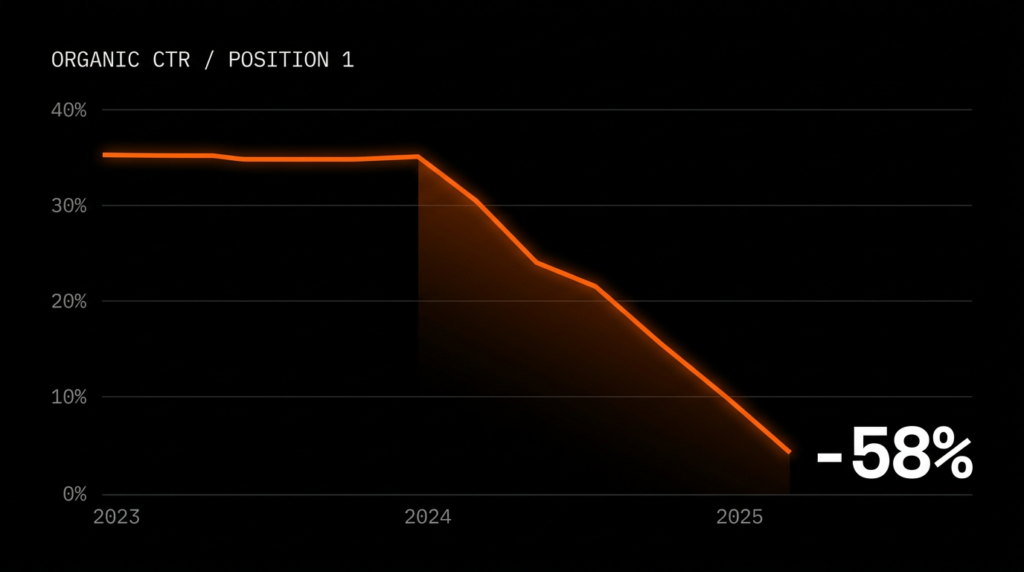
Here’s the stat that should stop every business owner cold: if your website ranks in the number one position on Google today, you’re now earning roughly 42 clicks for every 100 you would have earned two years ago. That’s an Ahrefs analysis of 300,000 keywords, measured in December 2025. A 58% reduction in clicks. For the top-ranking page.
Position two dropped 51%. Position three dropped 46%.
Your rankings didn’t change. Your traffic did.
Most small business owners looking at softer traffic numbers right now are reaching the wrong conclusion. They think their SEO is failing. They wonder if they need a new agency, a new strategy, a new set of keywords. They blame content quality or Google algorithm updates or their own inconsistent posting schedule.

None of that is what happened.
What happened is that the game itself changed. Not the rules — the game. The thing SEO was designed to win at for the last 20 years doesn’t exist in the same form anymore. And until you understand what replaced it, no amount of effort in the old system will bring those clicks back.
The good news — and there is real good news in this story — is that what’s replacing traditional SEO isn’t smaller. It’s actually bigger, more valuable, and for the first time in over a decade, genuinely winnable for small and medium businesses who move fast.
But first, you need to understand what actually broke.
What Actually Changed — The Death of the Click
For 20 years, search worked like a directory. You typed a question into Google. Google showed you ten links. You clicked one. You landed on a website. That website made money — from ads, from selling a product, from capturing your email, from building trust that turned into business later.
That was the deal. Google organized the world’s information. Websites provided it. Users clicked through. Everyone got something.
That deal is ending.
AI Overviews: Google Now Answers the Question Itself
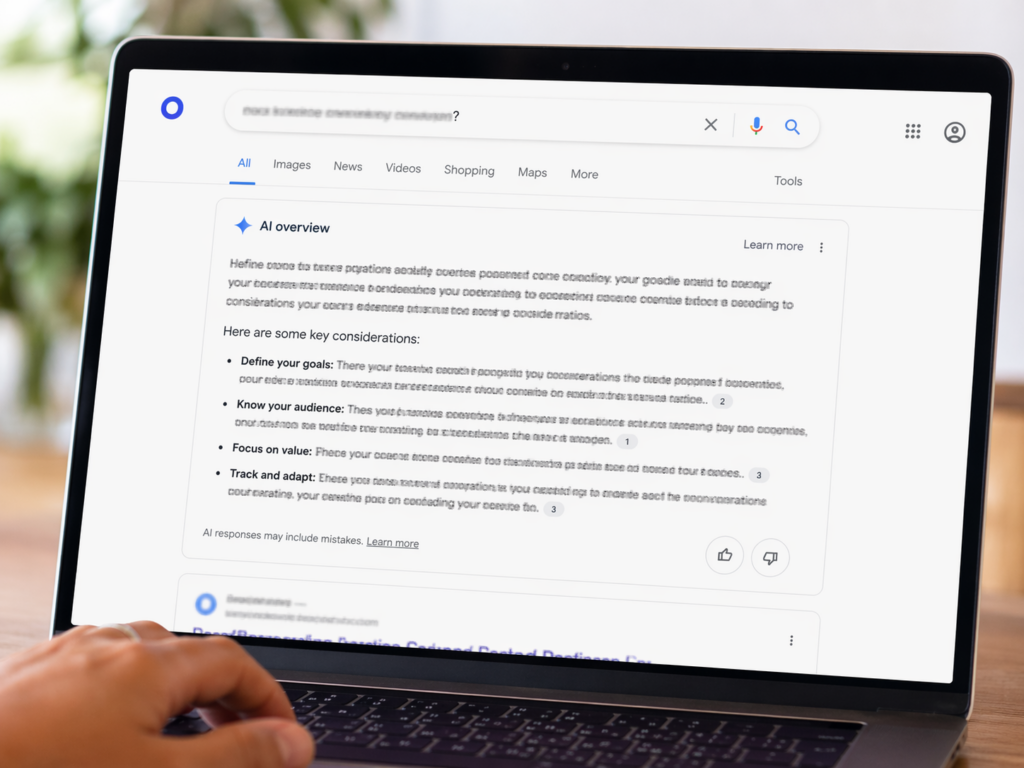
If you’ve searched Google in the last year, you’ve seen it. A box at the top of the results page that answers your question directly — synthesizing information from multiple sources into a clean paragraph, often with bullet points and citations. No clicking required.
That’s an AI Overview. Google rolled the feature out broadly in 2024, and by mid-2025 it was appearing in roughly 13-19% of all searches. By early 2026, that number had climbed well past 25% for common query types — and for informational searches specifically, some studies put the rate near 48%.
Here’s what that means in plain terms: nearly half the time someone asks Google a question that your business could answer, Google is now answering it for them. Your link might still be listed. It’s just listed below the answer — and most people never scroll that far.
Pew Research measured the behavioral shift precisely. When an AI Overview appears on a search results page, the click-through rate on traditional organic listings drops from about 15% to 8%. And only 1% of users actually click any of the citation links inside the AI Overview itself. The answer shows up, the user reads it, the user leaves satisfied. No website required.
Zero-Click Searches Became the Default
This shift has a name: zero-click searches. Searches that end without the user visiting any external website.
Zero-click searches aren’t new — Google has been answering simple questions directly for years (think “what time is it in Tokyo” or “how old is Tom Hanks”). What’s new is the scale.
Across all Google searches today, 43% now end without a single click to an external site. In Google’s newer AI Mode — a fully conversational search interface currently rolling out — that number jumps to 93%.
Read that again. In AI Mode, 93 out of every 100 searches result in zero traffic for any website, anywhere.
Bain & Company reports that 80% of consumers now rely on zero-click results for at least 40% of their searches. The cumulative effect, according to their analysis, is a 15-25% reduction in organic web traffic overall — and that’s the average across all businesses, including ones where the impact is far worse.
Gartner forecast a 25% decline in traditional search traffic by 2026. As of early 2026, that forecast isn’t a prediction anymore. It’s happening.
A New Generation Isn’t Using Google First
The AI Overview problem is actually the smaller half of this shift. The bigger half is where search itself is moving.
ChatGPT now has roughly 2.8 billion monthly active users. It’s the fourth most-visited site on the internet, ahead of X and Wikipedia. Its referral volume to external websites has grown into one of the largest traffic sources on the web — larger than Reddit, larger than LinkedIn.
Perplexity handles hundreds of millions of queries a month. Gemini crossed 650 million monthly active users by late 2025, with referral traffic growing 388% year over year. Claude has carved out a smaller but fast-growing professional user base. DeepSeek and Grok both crossed 3% of the AI chatbot market in under a year.
And crucially — users aren’t just using these tools. They’re using them first.
Similarweb’s January 2026 consumer research measured something genuinely important: when people begin researching a purchase, 35% now start with an AI tool. Only 13.6% start with a traditional search engine. AI holds a 2-to-1 advantage or greater at nearly every stage of the buying journey, from initial discovery all the way through brand evaluation.
The moment a potential customer first thinks about solving a problem your business solves, they’re now more likely to ask ChatGPT than to Google it. If your brand isn’t named in that ChatGPT response, you never enter their consideration set. You don’t get a second chance to appear later — because the shortlist was built before they ever opened a browser tab.
The Shift in One Sentence
Here’s the whole thing distilled down:
Search is no longer a list of websites. It’s a direct answer — and your business is either inside that answer, or invisible to the person asking.
That’s the change. Not an algorithm update. Not a temporary disruption. Not something that will correct itself when Google “figures out” that publishers are losing traffic. This is Google — and OpenAI, and Anthropic, and Google again with Gemini — rebuilding the entire interface between people and information.
For two decades, SEO was about being one of ten links on a page. The work was hard, the competition was real, but the game was knowable. Rank well, earn clicks, convert traffic.
That game still exists — but it’s been cut in half. And a completely new game has appeared next to it, with different rules, different winners, and a different prize entirely.
Which brings us to the most important insight in this entire shift: SEO didn’t die. It split in two. And understanding what those two halves actually are is the difference between businesses that survive this transition and businesses that quietly disappear from the internet over the next 18 months.
The Core Insight — SEO Just Split Into Two Pillars

For two decades, SEO had one goal. Just one.
Rank high on Google.
Everything a business did — the keyword research, the backlink building, the technical audits, the content calendars, the on-page optimization, the schema markup, the internal linking strategies — all of it served that single outcome. If you ranked, you won. If you didn’t, you lost. The entire industry, the entire vocabulary, the entire set of metrics every agency and in-house marketer measured themselves against, pointed at that one number.
That era is over.
Modern SEO now has two goals running in parallel. Not sequential. Not one replacing the other. Both, simultaneously, forever — or at least for the foreseeable future of how people find information online.
Pillar One: Authority
The first pillar is everything you already knew SEO to be. Ranking on traditional Google search. Earning quality backlinks. Building domain trust. Getting cited by reputable publications. Optimizing titles and meta descriptions. Structuring your site so search engines can crawl it. Producing content that demonstrates genuine expertise. Earning brand mentions across the web.
None of this went away. None of this stopped working. None of this became less important.
If anything, it became more important — and we’ll explain why in a moment.
This is the pillar most business owners already understand, at least conceptually. It’s what their SEO agency has been doing for them. It’s what the marketing blogs have been teaching for 15 years. It’s the work of becoming an authority that search engines trust.
Pillar Two: AI Visibility
The second pillar is new. Most small business owners have never heard it named. Most marketing agencies aren’t doing it yet. It has a formal name — Generative Engine Optimization, or GEO — but the practical meaning is simpler than the jargon suggests.
Pillar two is the work of getting your business cited inside the AI-generated answers that are rapidly replacing traditional search results.
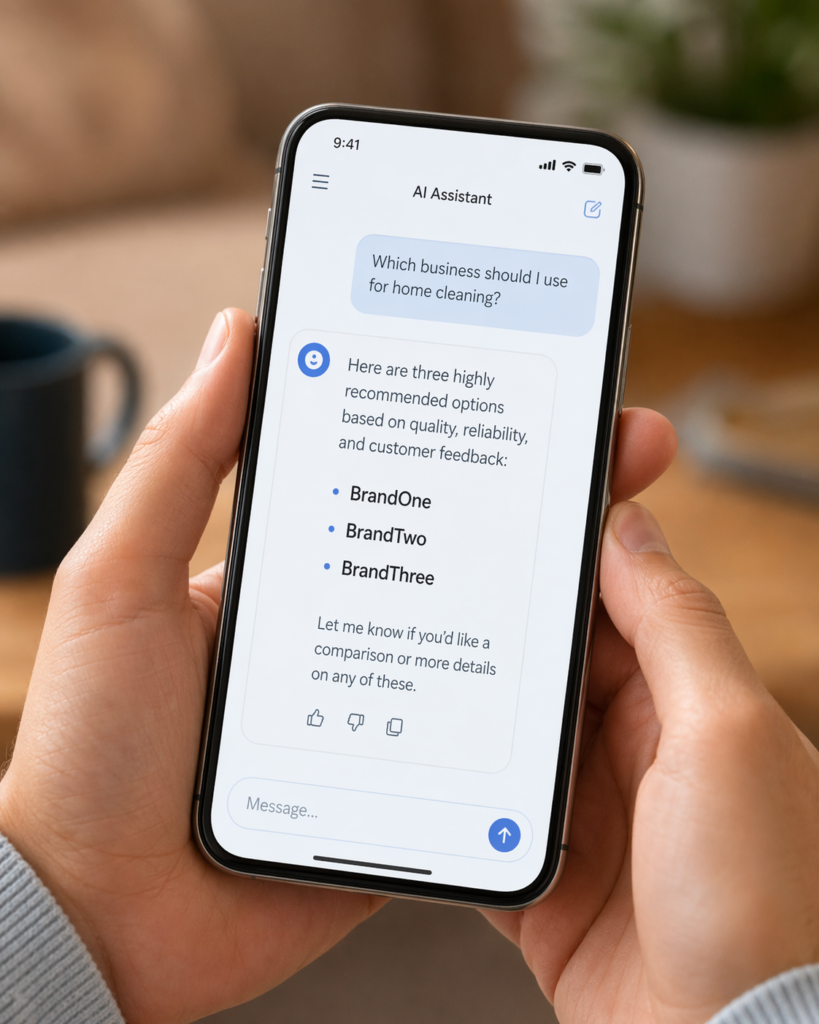
When someone asks ChatGPT which CRM is best for a small law firm, the answer names 3-5 brands. Pillar two is the work of being one of those named brands. When someone asks Perplexity for the best local HVAC company, the answer cites specific businesses. Pillar two is the work of being the business cited. When Google’s AI Overview summarizes the top options for a product category, pillar two is the work of being inside that summary.
This is a completely different discipline from traditional SEO. It requires different content structures, different optimization techniques, different measurement frameworks, and different strategies for each of the five major AI engines (Google AI Overviews, ChatGPT, Perplexity, Gemini, and Claude). Each engine has different preferences for who it cites and why.
We’ll go deep into what this work actually looks like later.
Why Both Pillars, and Why Now
Here’s the insight that most of the commentary on AI search is missing — and the one that matters most for your business.
These two pillars aren’t alternatives. You don’t get to pick one.
If you invest only in pillar one — traditional authority and rankings — you’ll keep showing up in Google search results, but you’ll watch your click-through rates continue to erode as AI Overviews eat more of the real estate above you. You’ll still exist on page one. You just won’t get the clicks you used to.
If you invest only in pillar two — AI citations and GEO — you’ll find yourself unable to earn those citations, because AI engines overwhelmingly cite brands that already have strong authority signals. They don’t cite random websites. They cite the sources they’ve been trained to trust — the ones with established backlinks, domain authority, and brand presence. Pillar two without pillar one is like trying to get invited to the wedding without knowing the bride.
The two pillars feed each other. Authority earns you the right to be cited by AI. AI citations drive brand searches, brand mentions, and new links — which strengthen authority. The businesses that will dominate their industries over the next decade are the ones running both pillars as a single integrated system.
What This Means for Your Business Right Now
If you’ve been investing in traditional SEO for years, you’re not behind. You’re actually ahead of most of your competitors — because you’ve already built the foundation pillar two requires. The work now is to add the second pillar on top of what you already have.
If you’ve been ignoring SEO entirely, the picture is harder but the opportunity is larger. You have to build both pillars at the same time — but unlike the last 20 years, the competitive landscape is genuinely open right now. AI engines haven’t finished deciding who to trust in most industries yet. There’s a narrow window, probably 12-18 months, where new entrants can establish citation positions that would have been impossible to win in the old Google-only world.
And if you’ve been investing in SEO but haven’t heard a word about pillar two from your current agency or marketing team — ask about it this week. Not next quarter. This week. Because every month you spend optimizing only for pillar one is a month your competitors are quietly establishing citation positions in the AI engines your customers are starting to use first.
Pillar One — Why Authority Still Matters More Than Ever
There’s a narrative spreading through marketing circles right now that goes something like this: AI search is the future. Traditional SEO is dead. Backlinks don’t matter anymore. Domain authority is a relic. Start over.
That narrative is wrong. And it’s going to cost businesses that believe it a lot of money.
Here’s what the data actually shows — and why the businesses that already invested in traditional SEO authority are sitting on a much more valuable asset than they probably realize.

AI Engines Cite Who They Trust — And Trust Is Built the Old-Fashioned Way
When Google’s AI Overview answers a question, it doesn’t pull sources at random. It pulls sources it has already decided are authoritative. When Perplexity cites its answers, it overwhelmingly cites sites with strong organic visibility. When ChatGPT names brands in a response, it names brands that appear frequently and favorably across the content it was trained on.
Ahrefs’ research on this point is striking. Websites with more organic traffic — the kind traditional SEO is built to produce — get significantly more mentions in AI Overviews and Perplexity answers. The correlation is strong and consistent across industries.
Why? Because AI engines have an existential problem humans don’t fully appreciate. They’re terrified of being wrong. Every hallucination, every bad citation, every confidently stated piece of misinformation damages the product. The companies building these engines have enormous incentives to cite sources that are already trusted — sources with established authority signals — because those sources are the safest bet against embarrassing errors.
The authority signals an AI engine looks at are the same ones Google has been weighing for 20 years. Quality backlinks from respected domains. Brand mentions across the web. Consistent presence in established industry publications. Technical signals that indicate a real, well-maintained business. Content depth that suggests genuine expertise.
If you’ve been building those signals for years, you’ve built the exact credential AI engines are now looking for when they decide who to cite.
The Narrowing Funnel Changes What Authority Is Worth
In the old Google world, authority earned you visibility on a page that showed ten links. Even if you ranked tenth, you had some chance of getting clicks. The market for attention was wide.
In the AI world, authority earns you a spot in a shortlist of three to five brands. No page two. No tenth place. No consolation ranking.
This changes the economics of authority entirely.
A business that ranked #7 for a valuable keyword used to get modest traffic. That same business, in the AI world, is either cited in the answer or it doesn’t exist. There’s no middle ground.
But — and this is the part most commentary misses — being one of the three to five cited brands is now dramatically more valuable than ranking #1 used to be. You’re no longer competing against nine other links for the user’s attention. You’re being actively recommended by a trusted source. The AI engine is essentially vouching for you.
The authority work that used to produce modest rankings now produces direct recommendations to high-intent buyers. The same inputs. A completely different output. And that output is worth substantially more.
What Counts as Authority in the AI Era
The fundamentals haven’t changed, but their relative weight has shifted. Here’s what AI engines appear to value most when deciding who to cite:
Quality backlinks from trusted domains. Still the clearest external signal that a source is credible. AI engines don’t have a direct “backlinks” metric the way Google’s algorithm does, but the sources they’ve been trained on and the sources they retrieve from overwhelmingly favor sites with strong link profiles. Backlinks aren’t just ranking signals anymore — they’re training signals, retrieval signals, and citation signals all at once.
Brand mentions across the open web. AI engines increasingly weight unlinked brand mentions. If your company name appears frequently across industry publications, Reddit threads, YouTube transcripts, news articles, and expert commentary — even without a hyperlink — the AI engine registers that as evidence of real-world relevance. This is relatively new. Old SEO largely ignored unlinked mentions. Modern AI visibility treats them as gold.
Depth and specificity of content. Surface-level content gets summarized and abandoned. Deep, specific, expertise-rich content gets cited as the source of the summary. The businesses earning the most AI citations right now are the ones publishing content only an actual expert could produce — with original data, first-hand experience, real examples, and the kind of specificity that can’t be faked.
Consistency over time. AI engines give weight to sources that have been trustworthy for years. A site that has published expert content consistently for five years carries more credibility than a site that launched six months ago, even if the newer site’s content is technically stronger. This is one of the few places where incumbency still matters.
Technical foundations. Fast sites. Clean code. Proper schema markup. Mobile-friendly experiences. Crawlable architecture. These have always mattered for Google. They now also matter for how easily AI engines can extract and cite content from your site.
The Uncomfortable Truth for Businesses That Skipped SEO
If your business hasn’t invested in traditional SEO over the last several years, the AI transition isn’t a clean slate.
It’s the opposite. The businesses that built authority through the old work have a massive head start into the new world. They’re already showing up in AI Overviews. They’re already being cited by ChatGPT. They’re already in the shortlist of trusted brands AI engines default to when answering questions in their industry.
New entrants have to build that authority from zero — and build it faster than they would have had to in the pre-AI era, because the window is closing. AI engines are finalizing their “trusted source” lists for most industries over the next 12-18 months. After that window, dislodging an incumbent citation becomes exponentially harder.
The honest read is this: pillar one work isn’t optional, and it isn’t yesterday’s work. It’s the foundation everything else sits on. Without it, pillar two — the AI visibility work we’ll cover in the next section — has nothing to build on.
What This Means Practically
If you’re running a small or medium business right now, pillar one translates into five things you should be doing regardless of what’s happening in AI search:
Earning quality backlinks from real, respected sources in your industry. Not spam. Not paid link schemes from dubious vendors. Genuine editorial links from publications, industry sites, and partners that actually carry weight.
Building brand mentions — linked and unlinked — across the open web. Getting quoted in articles. Appearing on podcasts. Contributing expert commentary. Being named in industry conversations wherever they happen.
Publishing deep, specific, expertise-driven content on your own site. Not thin articles. Not AI-generated fluff. Substantive work that demonstrates real knowledge and earns the right to be cited.
Maintaining technical excellence. Fast site. Clean structure. Proper schema. Mobile-first design. The basics that have always mattered and matter even more now.
Doing this work consistently over time. Authority compounds. Six months of inconsistent effort produces much less than 18 months of consistent effort — and the compounding is what creates the gap between businesses that become cited authorities and businesses that stay invisible.
None of this is new advice. That’s the point. The businesses that win pillar one in the AI era are the businesses that kept doing the fundamentals while everyone else got distracted by shiny new tactics.
Pillar Two — The New Discipline of AI Visibility
Now we get to the part most business owners have never done.
Pillar one is the work of being trustworthy. Pillar two is the work of being citable — structuring your content, your signals, and your presence so that when an AI engine generates an answer, your business is one of the three to five brands it names.
These are related, but they’re not the same discipline. A business can have strong authority and still be invisible in AI answers if its content isn’t structured for citation. And a business with weak authority can’t shortcut its way into citations through clever formatting alone.
Pillar two is the discipline of making your authority legible to AI engines. And it has its own name: Generative Engine Optimization, or GEO. Some practitioners call it AEO — Answer Engine Optimization. The names are interchangeable. The discipline is the same.
Here’s what it actually involves.
AI Engines Read Differently Than Humans
A human reader scans a webpage. They look at headlines, skim the first paragraph, maybe jump to a section that catches their eye, sometimes read deeply, often bounce in thirty seconds.
An AI engine doesn’t read. It extracts. It breaks your content into chunks, identifies which chunks contain answerable information, evaluates which chunks are cleanest and most self-contained, and pulls the ones that best answer the user’s query. If your content is structured in a way that makes extraction easy, you get cited. If it isn’t, you don’t — no matter how good the writing is.
This single shift — from reading to extraction — drives every tactic in pillar two.
Where AI Engines Actually Look
Research on AI citation patterns has surfaced one finding that changes how content should be written: roughly 44% of all citations from large language models come from the first 30% of an article.
The intro isn’t just important. It’s where most of the citation game is won or lost.
That means the old SEO approach — warming up with throat-clearing, telling a story before getting to the point, saving the best insight for the conclusion — actively hurts AI visibility. Content optimized for pillar two front-loads the answer. It states the core claim, the core number, the core recommendation early and clearly, and then expands with depth and evidence below.
This doesn’t mean the rest of the article doesn’t matter. It means the opening has to carry more weight than it used to. Your first few paragraphs are no longer the hook — they’re the citation.
The Formats AI Engines Prefer
Different content formats earn citations at dramatically different rates. The patterns are consistent across platforms:
Listicles dominate commercial queries. When users ask AI engines for “best X,” “top Y,” or “which Z should I buy,” the engine overwhelmingly cites list-based content. Roughly 41% of citations on commercial queries come from listicles. Not because list content is inherently better — because it’s structurally easier to extract from.
Articles dominate informational queries. When users ask “how does X work” or “what is Y,” AI engines prefer well-structured explanatory articles. About 45% of citations on informational queries come from this format.
Comparison pages outperform product pages. Content that explicitly compares options — “X vs. Y,” “A vs. B vs. C” — gets cited at much higher rates than content that describes a single option in isolation. Research has shown comparison pages with 3+ tables earn roughly 26% more citations than unstructured comparisons.
FAQ blocks and structured answer sections. Content that explicitly poses a question and answers it in one clean paragraph is dramatically more citable than content that buries the same information in narrative prose. The FAQ section isn’t just for users anymore. It’s for the AI engine reading your page.
Short sentences with clear claims. Shortlist content that averages 10 words or fewer per sentence earns roughly 19% more citations than prose-heavy equivalents. Density hurts extraction. Clarity helps it.
The takeaway isn’t that every article should become a listicle. It’s that the format should match the query intent. If users ask AI engines commercial questions about your category, your commercial content needs to be list-structured. If they ask informational questions, your articles need clear headings and extractable answers.
Schema Markup Stopped Being Optional
Schema markup — the structured data code that tells search engines what a piece of content is — used to be a nice-to-have. It helped Google display richer results, but a site could get by without it.
In pillar two, schema is the difference between being cited and being ignored.
AI engines use schema markup as one of their primary signals for what kind of content a page contains and how to extract it. A page with proper FAQ schema, Article schema, Product schema, Review schema, and Breadcrumb schema is dramatically more legible to an AI than a page without. The AI doesn’t have to guess what the page is about — the schema tells it.
Most small business websites have partial schema implementation at best. Pillar two work almost always starts with a comprehensive schema audit and buildout. Not glamorous. Extremely high leverage.
The Multi-Engine Problem
Here’s where pillar two gets genuinely difficult.
In traditional SEO, you optimized for one engine — Google. Sometimes Bing as a distant afterthought. The optimization was singular.
In pillar two, you’re optimizing for five engines simultaneously: Google AI Overviews, ChatGPT, Perplexity, Gemini, and Claude. And they don’t behave the same way.
Google AI Overviews lean heavily on traditional authority signals. Sites that rank well organically are disproportionately the ones cited. Schema markup and clear extraction structure help. Informational queries dominate.
ChatGPT pulls from a much wider pool of sources and is less correlated with traditional rankings. It weighs content depth, freshness, and brand mentions heavily. Structured content and comparison pages earn disproportionate citations.
Perplexity behaves most like a traditional search engine of the five. It heavily favors sources with strong organic visibility and publishes its citations transparently. If you’re ranking well on Google, you have a reasonable chance in Perplexity.
Gemini is fast-growing and tightly integrated with Google’s ecosystem. It weights YouTube content, Google Business Profile data, and Google-indexed content more heavily than other engines.
Claude has a smaller user base but higher-value traffic — often used by professionals and researchers. It appears to favor well-structured, source-dense content with clear reasoning.
Each engine has its own preferences, its own citation patterns, and its own quirks. Content that dominates in one can be invisible in another. Pillar two is the discipline of building content and structure that performs reasonably across all five — and tracking where you’re showing up, where you’re not, and why.

The Measurement Problem
Traditional SEO had clear metrics: ranking position, click-through rate, organic traffic, conversions.
Pillar two requires a different set of metrics, and most businesses aren’t tracking any of them:
Citation frequency. How often does your brand appear in AI answers for queries relevant to your business? This is the closest AI equivalent to “ranking position.”
Share of voice. Of all the brands AI engines could cite in your category, what percentage of citations does yours capture? A brand going from 5% to 15% share of voice is winning — even if raw traffic numbers haven’t moved yet.
Citation quality. Are you being cited favorably, neutrally, or negatively? Are you named as a top option or mentioned in passing? Position and context within a citation matter.
AI-referred conversion rate. When users do click through from AI engines, how do they convert compared to other channels? This number is often dramatically higher than Google organic — ChatGPT referrals convert at roughly 14% versus Google’s ~2.8% — which means even small amounts of AI traffic can represent outsized revenue.
Branded search growth. When AI engines cite your brand, users often search your name directly afterward to learn more. A lift in branded search volume is often the first measurable downstream effect of strong AI visibility.
None of these metrics appear in Google Analytics by default. Tracking them requires dedicated tools, dedicated process, and often dedicated personnel. This is one of the reasons pillar two is so poorly implemented across the SMB landscape — most businesses don’t even know what to measure yet.
What Pillar Two Work Actually Looks Like
If you’re wondering what this translates to as actual weekly work, here’s the shape of it:
Restructuring existing high-value content to front-load answers, add clear H2 and H3 structure, insert comparison tables, and include FAQ sections with extractable question-and-answer pairs.
Implementing comprehensive schema markup across the site — not just the homepage, but every key page, with the right schema types for each content category.
Publishing new content in formats aligned with how AI engines cite — listicles for commercial queries, structured articles for informational queries, comparison pages for consideration-stage buyers.
Building brand presence across the broader web — podcast appearances, industry publications, expert commentary, Reddit and forum contributions — so AI engines encounter your brand in multiple trusted contexts.
Monitoring citations across all five major AI engines continuously. Noticing when you appear, when you stop appearing, and what kinds of queries surface you versus skip you.
Iterating based on what’s working. Pillar two is significantly more experimental than traditional SEO. The engines change their behavior frequently, and the optimization playbook evolves in real time.
This is not a set-and-forget discipline. It’s an active, ongoing practice — more like running paid ads than like traditional SEO — that requires continuous attention and adjustment.
Why the New Channel Is Worth the Effort
At this point in the article, a reasonable SMB owner is thinking one of two things.
Either: This sounds like a lot of work on top of what I’m already struggling to do.
Or: This sounds expensive. I’m not sure I have the budget or the team to run two full SEO disciplines in parallel.
Both reactions are correct. Pillar two is real work. Running both pillars simultaneously is real investment. The question isn’t whether it’s hard — it is. The question is whether it’s worth it.
The answer, when you look at what the new channel actually produces, is an emphatic yes. The economics of AI search are different from anything SEO has ever offered before. And they favor businesses willing to do the work right now more than at any point in the last 15 years.
Here’s what the numbers look like.

AI Traffic Converts Dramatically Better Than Google Traffic
For two decades, Google organic traffic has been the gold standard of high-intent web traffic. Users searching Google already know what they want. They’re closer to a buying decision than someone scrolling social media. They convert better than almost any other channel.
AI search traffic is outperforming Google organic — not by a little, but by a factor of five to eight, depending on the platform.
ChatGPT referral traffic converts at roughly 14% on average across business websites. Google organic converts at roughly 2.8%. That’s a five-fold advantage per visitor.
Claude converts at approximately 16.8% — the highest of any major platform, despite having a smaller user base.
Perplexity converts at around 10.5%.
Even the lowest-converting major AI platform outperforms Google organic by a wide margin.
Why? Because by the time someone clicks a citation link from an AI answer, they’ve already been pre-qualified. The AI told them which brands to consider. The AI explained why. The AI answered their initial questions. The user who clicks through isn’t doing research — they’re finishing a decision.
Google organic traffic, by contrast, often arrives at the top of the funnel. Users are still figuring out what they want. They bounce, compare, leave, return, compare again. The path to conversion is long and uncertain.
AI traffic arrives at the bottom of the funnel. The comparison already happened — inside the AI. Your job is to close, not to educate.
The Traffic Volume Is Small But Growing Exponentially
The honest counterargument: AI referral traffic is still a small fraction of total web traffic. Depending on industry, it typically represents 0.5-3% of total sessions for most websites. That’s meaningfully below Google organic.
But look at the trajectory.
AI-referred sessions have grown 527% year over year on average. Generative AI traffic is growing 165 times faster than organic search traffic. ChatGPT alone is now sending more referral traffic to websites than Reddit, more than LinkedIn, and the curve is still bending upward.
Gemini’s referral traffic grew 388% year over year in the most recent measurement period. Gemini’s monthly active users grew from 450 million to 650 million in just three months in late 2025.
The current volume is small. The growth rate is unprecedented.
Similarweb’s data suggests AI search visitors will surpass traditional search visitors by 2028 on current trajectories. That timeline may prove conservative. The businesses building AI visibility now are establishing position in a channel that’s doubling roughly every year — and those compounding gains accrue to whoever shows up first.
Three percent of your traffic that converts at five times the rate of your Google organic traffic is already meaningful. Three percent doubling every year for five years is transformational.
The Winner-Take-Few Dynamic Changes the Value of a Citation
Here’s the structural insight that changes everything about how to value pillar two work.
Traditional Google search shows ten blue links. Even if you ranked seventh or eighth, you were on the page. You had visibility, even if you didn’t capture many clicks.
AI answers name three to five brands. Sometimes fewer. There is no page two. There is no tenth-place consolation. If you’re not in the named shortlist, you don’t exist in that query.
This sounds like a loss. It’s not — for the brands that earn citations.
If you’re one of the three brands named when potential customers ask ChatGPT for recommendations in your category, you’re effectively receiving a direct endorsement from a trusted source, multiple times per day, across hundreds or thousands of unique queries. The AI engine is vouching for you. The user is arriving at your site already told, by a neutral third party they trust, that you’re one of the best options available.
That’s not search traffic in the traditional sense. That’s something closer to word-of-mouth at machine scale.
The businesses earning consistent AI citations right now aren’t just getting traffic. They’re getting pre-sold buyers delivered at volume, on autopilot, from a channel their competitors aren’t even tracking yet.
The Field Is Genuinely Open Right Now
The most important point in this section, and possibly in the entire article, is this:
For the first time in more than a decade, the SEO landscape is genuinely up for grabs.
Between roughly 2010 and 2024, top Google rankings in most profitable categories were locked up by entrenched incumbents with large budgets and years of head start. A new entrant could win in niche corners or long-tail queries, but the head terms — the queries that actually drive business — belonged to whoever had been building authority the longest. The game wasn’t rigged, but it was calcified.
AI search reset the board.
AI engines haven’t finalized their “trusted source” lists for most industries yet. The models are still being trained and retrained. The retrieval systems are still being refined. The citation patterns for most commercial queries are still forming in real time. Whoever establishes authority in an AI engine’s view over the next 12-18 months becomes the default citation for that category for years afterward.
Think about what that means. An SMB in almost any industry has a narrow window to earn citations that, once established, will be extremely hard for competitors to dislodge. The cost of establishing those citations right now is a fraction of what it will cost in two years, when every major player in every category is competing for the same three to five slots.
This isn’t hype. It’s how AI retrieval and ranking systems actually work. Citations compound. Trusted sources stay trusted. The brands AI engines name today are disproportionately likely to be the brands they name in 2028 and 2030.
The businesses that treat this window as optional will look back in three years and recognize it as the most significant missed opportunity in their business’s history. The businesses that treat it as urgent will look back and recognize it as the single best marketing investment they ever made.
The Economics in Plain Language
If we strip everything down to what this means for a real SMB owner weighing whether pillar two is worth the effort, the math looks like this:
The channel is smaller today than Google organic, but growing ten to a hundred times faster.
The traffic converts five to eight times better than Google organic, which means even small volumes produce outsized revenue.
The competitive landscape is open in a way it hasn’t been in over a decade, which means the cost of winning position is lower today than it will ever be again.
The citations you earn now compound — earning more citations, driving more brand searches, attracting more links, strengthening authority, and feeding back into both pillars simultaneously.
And the businesses that don’t engage with pillar two aren’t just missing out on the new channel. They’re also watching their pillar one traffic erode as AI Overviews absorb more of the traditional Google real estate they used to occupy.
The work is real. The cost is real. But the businesses doing the math honestly are concluding that ignoring pillar two is more expensive than engaging with it — and that the opportunity cost of waiting is larger than the investment cost of acting.
The Closing Window — Why Speed Matters Now

Every major shift in digital marketing has had a window. A period when the rules were still being written, when early movers could establish positions that later entrants couldn’t easily dislodge.
Google SEO had that window from roughly 2003 to 2008. Businesses that figured out search rankings in those years held top positions for a decade or more. Facebook ads had a similar window from 2012 to 2016. Instagram influencer marketing had one from 2015 to 2018.
AI search is in that window right now. And it’s narrower than any of the previous ones.
How AI Engines Build Their Trusted Source Lists
AI engines don’t rank sources the way Google does. They build internal patterns of which brands to cite for which topics — patterns shaped by training data, retrieval signals, and reinforcement from user interactions over time.
Once those patterns solidify, they become sticky. A brand that establishes itself as a trusted citation for a category today is substantially more likely to remain the trusted citation a year from now, two years from now, five years from now. The engine has no strong reason to swap it out. Citations compound.
That’s the opportunity. It’s also the threat.
The Window Is Probably 12 to 18 Months
Based on how rapidly AI engines are expanding, how quickly citation patterns are stabilizing across industries, and how fast competitive awareness is spreading through the marketing world, the realistic window for establishing strong AI visibility in most categories is 12 to 18 months from right now.
After that window, the businesses already cited become the default. Displacing an incumbent citation requires significantly more effort than earning a citation in an open category. The cost of entry rises. The competitive moat of early movers widens.
This isn’t speculation. It’s how every previous digital marketing shift has played out, and there’s no reason to expect AI search to behave differently.
Why Waiting Guarantees You Lose
The instinct many business owners have is to wait for things to settle. Let the dust clear. Let best practices emerge. Let competitors experiment and learn from their mistakes.
In AI search, waiting is the mistake.
The businesses experimenting right now are establishing citation positions while the barriers to entry are lowest. By the time “best practices” become common knowledge, the field will have already been claimed by the businesses that moved early. The dust will have cleared around a set of winners who started 18 months before everyone else.
This is the inverse of how risk usually works in marketing. Normally, being early means being wrong more often. In AI search, being early is the safest position. Being late is the risky one.
What Early Movers Get That Late Movers Don’t
Businesses establishing AI visibility now get four compounding advantages:
Citation incumbency, which makes future citations easier to earn. Brand search lift, as users who hear about you through AI search your name directly. Authority reinforcement, as AI citations drive links, mentions, and signals that strengthen pillar one. And a continuous stream of pre-qualified, high-converting traffic while competitors are still debating whether any of this matters.
These advantages don’t stack linearly. They compound. A business that starts 12 months earlier than a competitor isn’t 12 months ahead. It’s often years ahead in practical terms — because every month of early lead produces advantages that make the next month’s work easier.
The Honest Framing
Every business owner reading this article is going to make one of three choices in the next 90 days.
Start building pillar two this quarter. Accept it’ll be imperfect at first. Learn in public. Improve over time. Establish position while the window is open.
Wait six months. See what competitors do. Start when the picture is clearer. Accept that you’ll be behind, but hope the gap is manageable.
Do nothing. Continue optimizing only for traditional search. Hope the AI shift stalls, reverses, or somehow doesn’t affect your industry.
The first choice is the hard one. It’s also the only one that positions the business to still be thriving in three to five years.
The window is open right now. It won’t stay open long.
The Businesses That Win the Next Decade
Twenty years ago, a handful of small businesses figured out Google search before most of their competitors did. They invested early, learned in public, built authority while the category was still forming. Those businesses became the names you now recognize as category leaders. The rest of their competitors — companies that were often larger, better funded, and better known at the time — spent the next two decades trying to catch up. Most never did.

That same moment is happening again right now.
This time it’s AI search. The timeline is faster, the winners will be fewer, and the rewards for getting it right will concentrate around the businesses that move first. But the shape of the opportunity is the same one a generation of business owners saw and acted on in 2005, and the consequences of missing it will be the same too.
The Thesis, One More Time
SEO didn’t die. It doubled.
The old work — authority, backlinks, technical foundations, substantive content, brand building — still matters. It matters more than ever, because it’s now the price of admission to the AI citations that increasingly drive discovery.
The new work — Generative Engine Optimization, multi-engine visibility, citation-ready content structure, AI-referred conversion tracking — is a parallel discipline that didn’t exist three years ago and will define who wins this category for the next decade.
The businesses that do both, consistently, starting now, will own their industries online in ways that will look obvious in hindsight and impossible to replicate in hindsight too.
Who Wins This Era
The winners won’t be the biggest businesses. They won’t be the best-funded. They won’t be the ones with the most sophisticated marketing stacks or the largest in-house teams.
They’ll be the ones who recognize the shift early, accept that the work has genuinely doubled, and commit to building both pillars while the window is still open. They’ll be the businesses willing to be imperfect in public for a year while they learn what works. They’ll be the ones who treat “start this quarter” as non-negotiable, not aspirational.
For the first time in more than a decade, small and medium businesses have a real shot at owning category-defining positions in search — positions that in the old Google-only world were locked up by entrenched incumbents with enormous budgets and decades of head start. AI search reset the board.
The businesses that see that and act on it will look back on this moment as the best marketing decision they ever made. The ones who wait will look back on it as the moment they lost ground they’ll spend years trying to recover.
The Bottom Line
The rules of search changed. Not slightly. Completely.
The old playbook still works for half the game. A new playbook is being written in real time for the other half. The businesses that win the next decade are the ones running both, starting now.
You don’t need to have it figured out. You don’t need a perfect strategy. You don’t need permission from your industry or certainty about how this will unfold.
You need to start.
The window is open right now. It won’t stay open long. And the compounding advantages of moving first — in AI citations, in authority, in brand visibility, in revenue — will accrue to whoever recognizes the moment and acts on it.
That’s the whole point. That’s the whole shift. That’s the whole opportunity.
Ready to See What AI Looks Like for Your Business?
At Intellic Labs, we don’t believe in generic demos or one-size-fits-all AI solutions. The same way this article asked you to meet your employees where they are, we meet your business where it is — inside your actual workflows, your real tools, and the specific friction points that are costing you time and revenue right now.

That’s why we created something a little different.
We’ll build you a free, custom AI walkthrough video — made specifically for your business.
Not a slide deck. Not a product overview. A short video built around your systems, your team, and your goals — so you can see exactly where AI can reduce friction, drive revenue, and create a better experience for both your customers and your people.
In your custom video, you’ll see:
✅ Where AI plugs into your existing stack — CRM, support, email, docs, and operations tools
✅ Which workflows can be fully automated end-to-end, not just “assisted”
✅ How we measure real ROI — cycle time, cost-to-serve, conversion, and resolution speed
✅ How we avoid the vendor lock-in and static platforms that leave most businesses stuck
No sales pressure. No buzzwords. No generic AI overview that could apply to any company on the planet. Just an honest look at what’s actually possible inside your operation — before you spend a dollar or a month in pilot purgatory.
We produce seven of these each week. Spots move quickly.
👉 Claim your free custom AI walkthrough video
Your team has more potential than any tool can unlock on its own. Let Intellic Labs help you show them what’s possible.