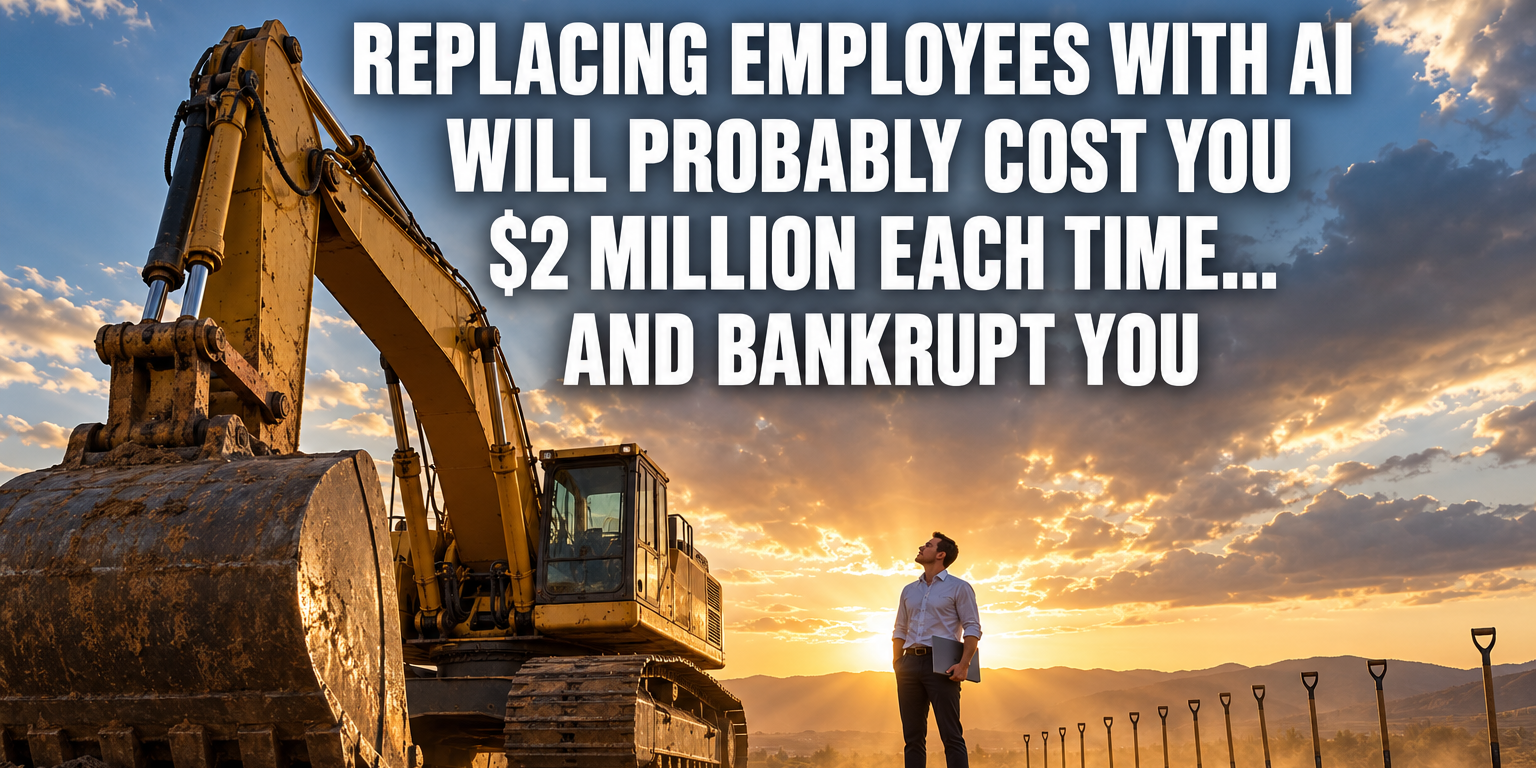
The spreadsheet
Somewhere today an owner is looking at a spreadsheet with two columns. One is salaries. The other is a software subscription. The second column is smaller, and the meeting is about how many names to move from the first column to the second.
Before anything else, which spreadsheet. Some owners are looking at a payroll the business can’t carry anymore. The model stopped working, the margin went with it, and a few people leaving now is how everyone else keeps their job. That’s a survival cut. Make it, make it fast, and make it honestly. There’s a section for you further down, because the arithmetic in this piece tells you who to keep. But the meeting I’m describing is a different one.
The payroll was fine last quarter. Nothing changed except a demo somebody watched, and now the question is how many names the subscription can replace.
That spreadsheet is wrong. The arithmetic is fine. It’s missing a line, and the missing line is bigger than both columns put together.
Here’s the short version. Every person you replace with AI is a person who could have been using AI. The companies pulling ahead right now aren’t the ones with the fewest people. They’re the ones with the most people who know how to make the machine work, and they are hiring yours to get more of them.
The two million in the title is a round number. I’ll show you where it comes from, and you can argue with every line. Argue the biggest line down by half and you’re still looking at a million dollars per name on that spreadsheet.
Before the arithmetic, the excavator.
The excavator
When the excavator showed up, one machine and one operator did the work of a crew with shovels. A contractor who kept paying the crew was finished within a few seasons.

But the excavator was expensive. You bought one, maybe two. You put your best operator on it, you let the shovel crew go, and that was the whole move. The price of the machine capped how far it could spread. It replaced ten people at the one hole that justified the lease, and everyone else kept their job because there was no second machine.
AI breaks that pattern three ways.
It’s cheap. A custom build that cost $50,000 three years ago costs $5,000 today and does ten times as much. A seat on a general-purpose model is a few hundred dollars a year. There is no lease to justify.
It’s wide. The excavator digs. AI writes the proposal, reads the contract, answers the phone at 2 a.m., reconciles the books, drafts the code and tests it. Any job that touches a keyboard is a job it can sit beside.
And it has no ceiling. One excavator moves one bucket at a time. One person with AI can run five things at once, and so can the person next to them, and the person next to them. There is no second machine to buy. The only limit on how much you get out of it is how many people you have who know how to direct it.
Put those three together. The excavator rewarded owning the machine. This rewards owning the operators.
That flips the arithmetic. The excavator math said fewer people, same output. This math says same people, several times the output. An owner who runs excavator math on a tool with no ceiling is firing the operators to save on shovels.
Where two million comes from
Take one person. $80,000 salary, call it $100,000 with benefits and overhead. The spreadsheet says replacing them with AI saves $100,000 a year, half a million over five years, minus a subscription.
That’s the column you have. Here’s the one you don’t.
The walk-back. In February 2026, Careerminds surveyed 600 HR leaders who had run layoffs in the previous year. Among the companies that cut roles for AI, 68% had already rehired at least a quarter of them, and half of those rehired within six months. Thirty-one percent paid more to restaff than the cuts had saved. Gallup puts the cost of replacing one employee at half to twice their annual salary, so on $80,000 that’s $40,000 to $160,000, before you count what walked out the door. A third of the companies in that survey said they lost critical skills they couldn’t get back, and 55% said the technology needed more human oversight than they’d planned for.
Price the walk-back at $100,000. For one company in three it ate the entire savings line. That’s the small number.
The multiplier you gave up. PwC’s 2026 AI Jobs Barometer tracked company financials across 27 countries. At the top fifth of AI-exposed companies, output per worker rose 163% between 2018 and 2025. More than two and a half times the output, per head, in seven years.
The person you just cut was your seat at that table.
Most businesses paying $80,000 salaries run somewhere between $200,000 and $300,000 in revenue per head. Use $250,000. Multiply by 2.6 and the same person, with the tool, is producing $650,000. The gap is $400,000 a year. Over five years, $2 million.
That’s the title. You traded $2 million of output for half a million of savings, and a one-in-three chance the savings never show up.
Now argue it down. PwC’s figure is for the companies that did this best, and it includes seven years of ordinary growth. The least AI-exposed companies grew 24% in the same window, so strip that out and the gap is still a doubling. Run it at 2x and the line is $1.25 million. Run it at 2x over three years and it’s $750,000. I can’t get it under half a million without assuming your people never learn the tool.
The title is the top of the range. The bottom of the range is still two and a half times what you saved.
The competitor. The person you cut didn’t vanish. They went somewhere. AI skills now carry a 62% wage premium, up from 57% a year earlier, and postings for AI-skilled roles are growing eight times faster than the job market as a whole. Someone is paying up for people who know what they’re doing.
You don’t have to pay that premium. Teach the people you already have. A course and a month of practice costs a fraction of one hire at 62% over market, and the person who learns on your payroll automates your workflows while they learn. If they leave afterward, so be it. The automation stays, and you’re ahead of where you started.
Look at who’s paying. Lovable, an AI coding company, reported around $400 million in annual recurring revenue in early 2026 with 146 full-time employees. That’s $2.7 million per head. The average public software company runs about $300,000. The firms built on this technology are getting seven to nine times the output per person that a conventional company gets, and they are hiring.
The third line never shows up on your books. It shows up on theirs.
What the replacers found out
The companies that ran the excavator math loudest have had two years to see how it went.

Klarna announced in February 2024 that its AI assistant was doing the work of 700 customer service agents. It froze hiring, let headcount fall 22% through attrition, and told the remaining staff to use AI to cover the gaps. In May 2025 the CEO told Bloomberg the cost savings had come with “lower quality,” that there would always be a human if you wanted one, and that investing in human support was “the way of the future for us.” Klarna is hiring agents again.
That’s one company. The surveys say it’s the pattern.
Orgvue asked 1,163 senior leaders across eight countries in early 2025. Thirty-nine percent had made people redundant because of AI. Of those, 55% said they’d made the wrong call. Forrester’s prediction for 2026 was that half of all AI-attributed layoffs would be quietly reversed, with the jobs coming back offshore or at lower pay. Gartner expects half the companies that planned to cut customer service staff for AI to abandon the plan by 2027. And of the 600 HR leaders Careerminds surveyed this year, 8% said they’d do it the same way again.
Eight percent.
There’s a reason this keeps failing, and it isn’t the technology. An MIT report in August 2025, built on 300 public AI deployments and 150 executive interviews, found that 95% of corporate AI pilots produced no measurable return. The researchers blamed what they called a learning gap between the tool and the workflow, not the model. Tools bought from vendors and wired into the workflow succeeded about two thirds of the time. Internal builds, one third.
The tool didn’t know the workflow. The person you replaced did.
Now look at the companies that did the other thing. IBM’s CEO told the Wall Street Journal in May 2025 that AI had taken over a couple hundred HR roles, and that total headcount went up, because the money went into programmers and salespeople. PwC’s barometer found that headcount at the most AI-exposed companies grew 52% since 2018, against 36% at the least exposed. The companies with the most AI have the most people, and they are out buying operators.
That’s the competitive environment you’re actually in. Not you against the machine. You against a company that read the same spreadsheet and moved the names the other direction.
The person you can’t lose
Here’s what the research says the tool does for a person who learns it.
Stanford and MIT economists followed 5,179 customer support agents through a staggered AI rollout. Issues resolved per hour rose 14% on average and 34% for the newest agents. Customers were happier and the agents stayed longer. Harvard and BCG ran 758 consultants through real client tasks: 12% more tasks finished, 25% faster, and quality scored 40% higher. Those are single-task gains from tools two or three generations old. The PwC multiplier is what they compound into over years.

And one counterexample, because it matters. In 2025, METR put 16 veteran open-source developers through a controlled trial with the best coding tools on the market. They expected to be 24% faster. They were 19% slower. Nearly half had never used the main tool before the study, and they spent their time prompting and waiting instead of coding.
That’s the whole lesson in one experiment. The gain lives in the person who learned to drive the tool, and that person has to be built.
I’ve watched two get built. An insurance company I work with took the dialing away from its cold callers and moved them onto sales, and they close far more than they used to. A contractor who used to lose his evenings to proposals now spends almost none of his time on paperwork. Nobody on either team was replaced. The job got bigger and the person grew into it.
Now the market. AI skills carry a 62% wage premium. Postings that ask for them are growing 69% against 9% for everything else. And in Orgvue’s survey, 34% of leaders said employees had quit as a direct result of AI. Read that beside the 55% who regret the layoffs. I’d bet the ones who left weren’t the ones who refused to learn. They were the ones who watched the spreadsheet meeting happen and got out before their name came up.
So here is the person you can’t lose. The employee who automates their own job has just told you three things: they understand the work well enough to specify it, they can direct the machine, and they now have most of a week free. That is the operator. Letting them go because the job “got automated” is the exact move the excavator contractor made, except this machine was free and there were nine more holes to dig.
That person gets the next five people’s worth of work and a raise, because the firm down the road will pay 62% over market to take them off your hands.
The person you’ll have to let go
That leaves the ones who won’t learn it.
I’m not going to dress this up. If the tool has no ceiling, and the only limit is the number of people who can direct it, then a person who refuses to direct it is a person with a ceiling in a building that no longer has one. You can carry that for a while. You can’t carry it next to a competitor who carries none of them.
Give them time, training and a real reason first. In the Careerminds survey, 55% of companies never formally discussed reskilling before they cut, and half said up to a quarter of the roles they eliminated could have been redeployed. Most of the people written off as unable were never asked. Ask. Pay for the course. Put your best operator next to them for a month.
Then, if the answer is still no, it’s no. Not because the machine replaced them. Because they declined the job the machine created.
That’s the difference between those two cuts. Letting go of someone who refuses to learn is a decision about one person. Letting go of the people who did learn, to save a subscription, is a decision about every person who was watching.
If you have to cut anyway
Some of you have to cut regardless. The margin is gone, and five people leaving now is how the other fifteen keep their jobs. Make the cut. Nothing above argues against it. The arithmetic just tells you who stays.
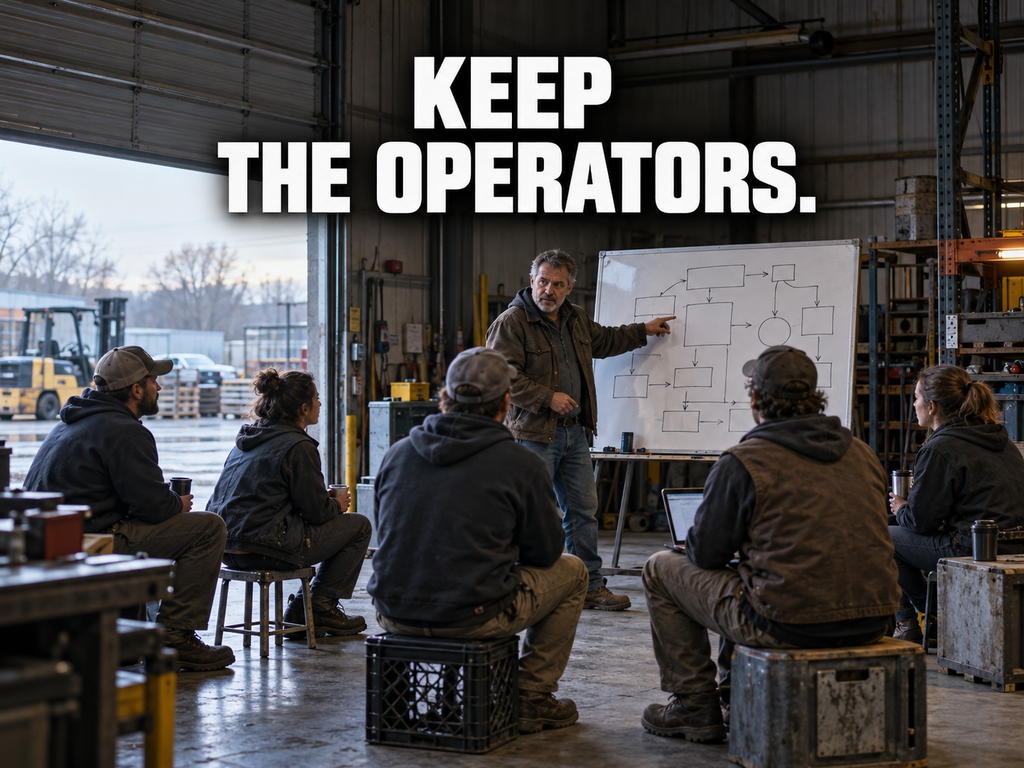
Keep the operators. The person who has already moved half their job onto the machine is the cheapest capacity you own, because they’re carrying their own role and part of someone else’s. Cut around them. If you have two people in a role and one of them has learned the tool, the choice makes itself, and it has nothing to do with seniority.
And call it what it is. If the money is gone, say the money is gone. Dressing a survival cut up as an AI strategy sets an expectation the tool then has to meet, and the surveys above are what it looks like when it doesn’t. Your people can read a spreadsheet too, and the ones you keep will remember which story you told.
Fewer people with the tool beats more people without it. Fewer people without the tool is just a smaller company.
To your people
If you’re an employee reading this over your owner’s shoulder, this part is yours.

Everything above is a description of the position you’re in. The companies that cut regret it at 55%. The companies that kept and trained are growing headcount faster and paying 62% more for the skill. The newest agents in the Stanford study got the biggest gains, which means the person with the least seniority has the most to pick up. And the developers who came out 19% slower were mostly on a tool they’d never used. The hours you put in before it counts are the whole difference.
So become the person who can replace themselves. Take your own job, the whole thing, and work out how much of it the machine can carry if you set it up right. Then set it up. Write down what it can’t do. Hand the first part to the machine and keep the second.
The fear is that you’ve just typed your own pink slip. Look at the arithmetic again. An owner who cuts you after that is giving up $2 million to save half a million, and two times in three he’ll be rehiring within the year. An owner who keeps you has just found the one person in the building who knows what the rest of the week is for. And if yours turns out to be the first kind of owner, you’re holding the most hireable skill on the market, with a 62% premium waiting at the second kind.
Either way you’re fine. The only way to lose is to wait and see.
The longer version of that, written for you rather than for the person holding the spreadsheet, is next.